
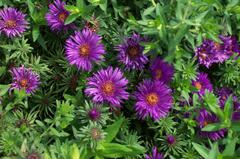
Description

SYMPHYOTRICHUM NOVAE-ANGLIAE ‘PURPLE DOME’
If you’ve been searching for something that handles wet soil, deep shade, and Connecticut winters without complaint while still delivering a show-stopping display of color, the Purple Dome New England Aster might just be the plant you’ve been waiting for. This compact native cultivar has a reputation for dependability that borders on legendary among experienced gardeners, and once you grow it, you’ll understand why. Unlike its taller cousins that often flop and sprawl by midsummer, Purple Dome stands upright, self-supporting, and absolutely smothered in bloom from late summer straight through the first hard frost.
What it looks like
Purple Dome is a study in restraint and abundance—a paradox that makes it so valuable in the garden. The plant forms a dense, compact mound with fine, linear foliage that stays green and composed all season long. Starting in mid-to-late August, it erupts into a firework display of semi-double flowers in a rich, complex purple-violet shade that seems to shift depending on the light. The blooms are the size of a dime, produced so prolifically that sometimes you can barely see the foliage beneath them. The overall effect is like someone set off a bottle rocket made entirely of flowers, and unlike taller asters that tend toward that leggy, tired look by October, Purple Dome maintains its tidy mounded shape from first bloom until final frost.
Growing it in your garden
Here’s what makes Purple Dome special: it thrives in conditions that would exhaust other plants. New England is famous for its wet springs and soggy autumn weather, and this native aster genuinely prefers moisture. It’s not fussy about soil quality—acidic, neutral, alkaline, rich, lean, it adapts to all of it. Full sun is ideal (six or more hours daily), but it will perform respectably in part shade, which is unusual for asters. Plant it in spring or early fall, spacing plants about two feet apart. The compact mature size means it won’t require staking or aggressive pruning to maintain its shape, which saves you time and frustration come July when everything else is demanding attention.
Through the seasons
Spring arrives and Purple Dome emerges as a neat little mound of fresh green foliage. Throughout summer, it grows steadily without drama—no floppy stems, no desperate need for deadheading or pruning. By late August, when many gardens begin looking tired, Purple Dome awakens. The buds form first in weeks of anticipation, then suddenly—seemingly overnight—they open into a cloud of purple flowers. This display intensifies through September and early October, reaching its peak color and abundance right around the time that many perennials have already faded. Even after the first killing frost, the flowers retain their color longer than many asters, extending the show well into November in Connecticut. The dried seed heads remain decorative through winter, providing texture and interest when the garden needs it most.
Where it shines
Purple Dome is an absolute powerhouse in the late-season border, particularly in rain gardens and low spots where water collects. Plant it in drifts of three or five for impact, or use it as a structural element to anchor fall containers combined with ornamental grasses and sedum. It’s spectacular in cottage gardens, native plant communities, and pollinator gardens—the late flowers are absolutely critical for monarchs and other butterflies preparing for migration. Because it stays compact and never looks messy, it also works beautifully in more formal settings, even tucked into perennial beds where you’d normally avoid taller, looser asters. It combines beautifully with ornamental grasses, particularly the warm tones of Miscanthus or Panicum, and next to the pale panicles of Hydrangea PANICLE.
Perfect companions
Pair Purple Dome with the pale greenish-white flowers of HYDRANGEA PANICULATA ‘GRANDIFLORA’ for a sophisticated late-summer combination. Combine it with burgundy-leaved Heuchera for foliage contrast, or let it mingle with the silvery stems of Artemisia. The blue-purple tones look stunning backed by golden ornamental grasses like Panicum VIRGATUM ‘SHENANDOAH’, and it creates wonderful depth planted in front of Cimicifuga for a two-toned purple effect.
Care tips
Water regularly during the first season to establish a deep root system, then it becomes quite drought-tolerant in subsequent years (though it prefers consistent moisture). Deadheading spent flowers prolongs the display, but it’s entirely optional since the plant looks good at every stage. Some gardeners like to cut it back in spring once new growth emerges to encourage an even bushier, more compact form. Beyond that, Purple Dome asks for almost nothing—no staking, no fussing, no drama.
Quick facts
- Hardiness Zone: 3–8 (thrives throughout Connecticut)
- Mature Height & Spread: 18–24 inches tall and wide
- Bloom Season: Late August through November
- Light Requirements: Full sun to part shade (6+ hours ideal)
- Water Needs: Medium to wet; prefers consistent moisture
- Available at: Both our retail and wholesale locations