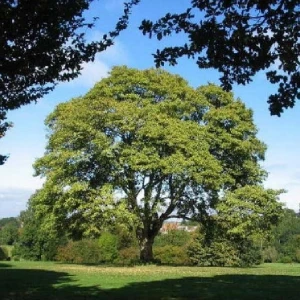
Description
PLATANUS OCCIDENTALIS
There’s a reason American Sycamores have anchored Connecticut’s riverbanks and meadows for centuries—they’re the ultimate expression of what a shade tree can be. Massive, magnificent, and magnificently tough, this native giant doesn’t just survive in New England; it thrives, commanding respect with its sheer presence and delivering four-season visual drama that few trees can match.
What it looks like
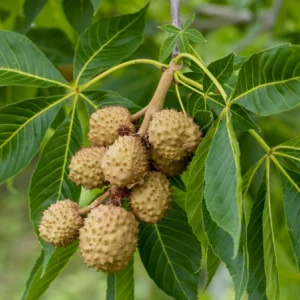
The American Sycamore is a statement tree in every sense. At maturity, you’re looking at a truly colossal specimen—we’re talking 75 to 100 feet tall with a spread nearly as wide. But what really makes people stop and stare is that exfoliating bark. Throughout the year, especially winter, the outer bark peels away in irregular patches to reveal cream, white, and pale greenish-gray wood underneath. It’s almost like someone’s canvas painting itself. The leaves are large—5 to 10 inches across—and deeply lobed, turning a warm golden-brown in fall. In spring and early summer, the tree produces curious spherical seed balls about an inch in diameter that dangle from the branches like ornamental puzzles.
Growing it in your garden
Here’s what makes the American Sycamore so valuable in Connecticut landscapes: it’s genuinely unfussy. This tree evolved to handle whatever New England throws at it. It loves moisture and is actually one of the best choices for poorly drained soils, wet areas, or sites near streams and ponds where other trees would struggle. That said, it’s adaptable enough to perform well in average soil too. Plant in full sun to partial shade—the more light, the more robust your tree will be. American Sycamores are fast growers, so if you’re planting one, you’re making a long-term commitment to your landscape. But that growth rate means you’ll see real transformation within a few years.
Through the seasons
Spring brings unfurling leaves and those intriguing flower clusters (not showy, but part of the tree’s charm), followed by the development of those distinctive seed balls. Summer is when this tree truly shines as a shade provider—dense foliage creates cool, dappled light perfect for sitting beneath on hot Connecticut afternoons. Fall delivers that warm, buttery-gold color change, and then comes the real winter show: with leaves gone, the patchwork bark pattern becomes the focal point, offering visual interest when so many trees look dull and uniform. It’s a four-season performer that earns its space.
Where it shines
The American Sycamore is a tree for larger properties and open landscapes where it has room to spread its considerable canopy. Native plant enthusiasts love it because it’s genuinely native to Connecticut and supports native insects and wildlife. It’s exceptional along property lines, near water features, or in areas where you want a dominant shade tree that makes a visual statement. This isn’t a tree for tight suburban spaces—it demands room to be itself. But in the right location, it’s unbeatable.
Perfect companions
Pair the American Sycamore with other water-loving native plants like Spicebush, Arrowwood Viburnum, or Sedges in the understory. Its open shade is actually perfect for shade-tolerant wildflowers like Echinacea or native ferns. If you’re creating a native plant community, PLATANUS OCCIDENTALIS is an anchor around which everything else builds.
Care tips
Once established, American Sycamores need minimal care—think of them as self-sufficient. In early years, consistent moisture helps develop a strong root system, but mature trees are remarkably drought-tolerant despite their love of wet sites. Pruning is rarely necessary; the tree naturally develops beautiful form. The seed balls and fallen leaves create some cleanup, but many gardeners consider that character rather than burden. Watch for anthracnose in particularly wet springs (a Connecticut concern), but resistant strains are widely available. Our team can guide you toward the healthiest specimens.
Quick facts
- Hardiness Zone: Zones 4-9
- Mature Height & Spread: 75-100 feet tall, 75-100 feet wide
- Bloom Season: Spring (inconspicuous flowers)
- Light Requirements: Full sun to partial shade
- Water Needs: Prefers moist soil; excellent for wet sites
- Available at: Both our retail and wholesale locations