


SMALL / MEDIUM TREES
(15-30 ft. tall)
(15-30 ft. tall)
Flowering Dogwood
(Cornus Florida)
- Flowers have 4 big white/pink bracts (not petals) that form a cross-like shape around a small cluster of yellow-green flowers in the center that resembles the look of a mini pinecone.
- Leaves grow in opposite pairs which have curved veins to follow the edge of the leaf.


American Hornbeam / Musclewood
(Carpinus Caroliniana)
- Bark has a “muscular” appearance and sinewy feel– it is smooth and dark gray
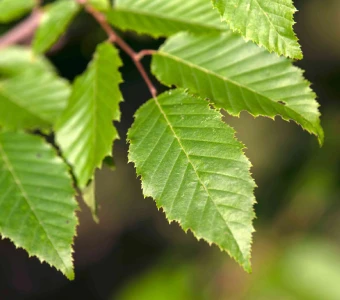
- Leaves are ovate, alternate, and have a doubly-serrated margin (tiny teeth on top o fbigger teeth along the edges).

Serviceberry
(Amelanchier Canadensis)
- Flowers have 5 narrow, white petals, to give them a star-like appearance where they often appear in drooping clusters at the branch tips.
- Fruit starts red and ripen to a dark blue or purple which look like tiny blueberries- they’re edible!


American Hophornbeam / Ironwood
(Ostrya Virginiana)
- Bark is light brown to gray, grooved, and sheds in thin, vertical strips to look stringy.
- Fruit looks like clusters of small, papery-enclosed nutlets that look like hops flowers.


River Birch
(Betula Nigra)
- It grows as a large shrub or small tree in the shaded understory and its branches have a zigzag pattern.
- Leaves are broad, oval, with wavy edges where the base of the leaf is often asymmetrical. Ornamental flowers in the Fall.


Eastern Redbud
(Cercis Canadensis)
- Bark has a “muscular” appearance and sinewy feel– it is smooth and dark gray.
- Leaves are ovate, alternate, and have a doubly-serrated margin (tiny teeth on top of bigger teeth along the edges).


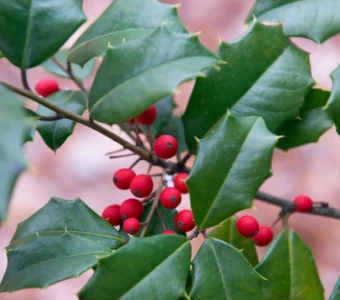
American Holly
(EVERGREEN)
- Leaves are fern-like and bipinnately compound meaning each leaf is made up of several small leaflets to give that feathery look.
- Makes long, dark brown pods that are twisted and are produced in clusters which contains seeds and a sweet pulp.

Witchhazel
(Hamamelis Virginiana)
- It grows as a large shrub or small tree in the shaded understory and its branches have a zigzag pattern.
- Leaves are broad, oval, with wavy edges where the base of the leaf is often asymmetrical. Ornamental flowers in the Fall.


LARGE TREES (30+ FT. TALL)
Red Maple
(Acer Rubrum)
- Leaf margins are double-toothed, have 3 to 5 lobes (most common with 3), and turn from green to red with the underside being whitish.
- Has opposite branching meaning the twigs/buds and leaves grow in pairs directly across. from each other on the stem.


Honey Locust
(Gleditsia Triacanthos)
- Leaves are fern-like and bipinnately compound meaning each leaf is made up of several small leaflets to give that feathery look.
- Makes long, dark brown pods that are twisted and are produced in clusters which contains seeds and a sweet pulp.


Sycamore/ American Planetree
(Platanus Occidentalis)
- Bark peels off in patches to reveal a mix of white, tan, gray, and green colors underneath which give it a camouflage look.
- Leaves are huge, with 3 to 5 lobes which look like a maple but much larger.


American Elm ‘Princeton’
(Ulmus Americana)
- Bark has a sponge-like texture. Disease resistant variety.
- Leaves are oval, have a doubly-serrated margin, uneven bases where one side of the leaf base is usually lower than the other and the top of leaves feel like sandpaper.


Pin Oak
(Quercus Palustris)
- Leaves have 5-7 deep, u-shaped lobes that go almost to the midrib and have bristly, pointed tips.
- Lower branches droop, middle branches stick out, and upper branches angle upwards resembling the shape of a pyramid.


Northern Red Oak
(Quercus Rubra)
- Leaves have 5-7 deep, u-shaped lobes that go almost to the midrib and have bristly, pointed tips.
- Lower branches droop, middle branches stick out, and upper branches angle upwards resembling the shape of a pyramid.


White Oak
(Quercus Alba)
- Leaves have 7-9 rounded lobes that are deep, even, and cut to the midrib lacking bristle-tips with the color being a bluish-green on top and slightly fuzzy underneath.
- Bark is usually light gray and may have scaly or flaky with bigger teeth along the edges.


American Beech
(Fagus Grandifolia)
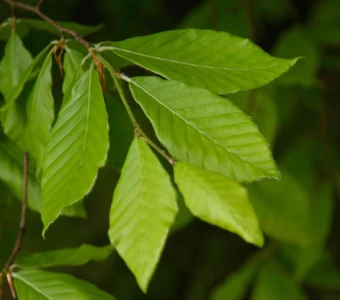
- Bark is smooth, blue-gray and is often compared to elephant skin or concrete.
- Leaves are alternate, simple, oval or elliptic in shape, and the veins run parallel.

Black Cherry
(Prunus Serotina)
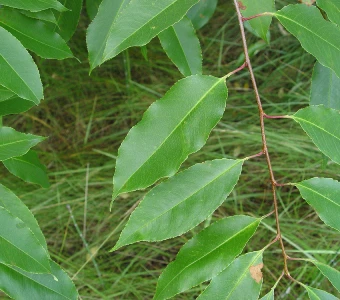
- Bark has prominent horizontal white lenticels and if you scratch on the twigs it will give off a foul bitter smell but the second time it will smell sweeter like an almond.
- Leaves have an underside with rusty-brown or orange hair along the midrib.

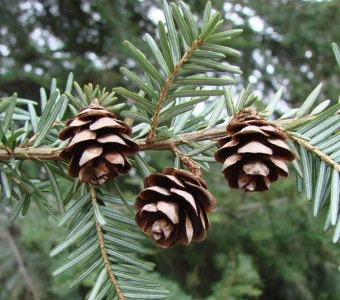
Eastern Hemlock (EVERGREEN)
(Tsuga Canadensis)
- Needles are soft, flat, taper from the base to apex, have a short petiole, and contain 2 white lines (or stomates) on the underside.
- Cones are oval, roundish, and small being only about ¾ inch long which hang down like mini ornaments.

Eastern Red Cedar (EVERGREEN)
(Juniperus Virginiana)
- Leaves are small and scale-like, closely overlapping and pressed against twig forming a 4-sided branchlet.
- Cones are ¼ inch (often called berries), round, hard, pale green to dark blue depending on maturity, and has a glaucous coating.


Black / Sweet Birch
(Betula Lenta)
- Leaves are similar to paper birch but have a heart-shaped base, sharply toothed, aromatic, and the veins branch toward edges.
- Bark is a smooth, shiny, dark brown with white horizontal lenticels which when bruised or cut with smell like wintergreen


Tulip Tree / Yellow-Poplar
(Liriodendron Tulipifera)
- Leaves are bright green, alternate, simple, have four-symmetrical, pointed lobes that are notched at the tip to resemble a tulip in outline, and produce a spicy aromatic when crushed.
- Fruit develops upright cone-shaped seed clusters.


Shagbark Hickory
(Carya Ovata)
- Bark peels off in long, loose, vertical strips which gives the trunk a shaggy appearance.
- The leaves are pinnately compound with 5 leaflets which are pointed and serrated where the terminal leaflet is the largest.


Pignut Hickory
(Carya Glabra)
- Leaves are compound with 5-7 narrow, sharply pointed, and finely toothed edged leaflets which give off a spicy scent when crushed.
- Nuts are smooth, oval shaped, and contains a thin husk that splits partway open which is less thick and rough than other hickories.


Sweetgum
(Liquidambar Styraciflua)
- Leaves have 5 pointed lobes that are arranged into a star shape which are shiny and green in the summer and bright red/orange in the fall.
- Produces round, woody seed balls covered in stiff spines that drop in late fall and winter


Swamp White Oak
(Quercus Bicolor)
- Leaves are oblong with wavy lobed edges that are not deeply cut and are shiny dark green on top while being pale, whitish, and velvety on the bottom.
- Mature bark is gray and scaly while the younger branches have flaky and peeling bark.


American Basswood / Linden
(Tilia Americana)
- Leaves are oblong with wavy lobed edges that are not deeply cut and are shiny dark green on top while being pale, whitish, and velvety on the bottom.
- Mature bark is gray and scaly while the younger branches have flaky and peeling bark.


Ohio Buckeye
(Aesculus Glabra)
- Leaves are oblong with wavy lobed edges that are not deeply cut and are shiny dark green on top while being pale, whitish, and velvety on the bottom.
- Mature bark is gray and scaly while the younger branches have flaky and peeling bark.


Eastern White Pine (EVERGREEN)
(Pinus Strobus)
- Needles are soft, flexible, and bluish green which grow in bundles of 5.
- Cones are 4-8 inches long, narrow, and slightly curved with thin, flexible scales which often have drops of white resin on them.


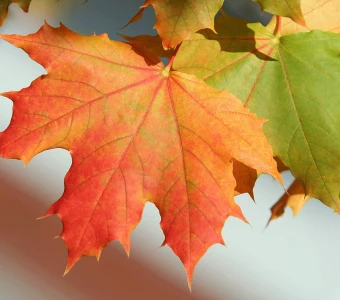
Sugar Maple
(Acer Saccharum)
- Leaves have 5 distinct lobes with smooth, U-shaped sinuses which turn a yellow-orange in the fall.
- Produces clear, sweet sap in early spring, which is boiled down to make real maple syrup.

Sassafras
(Sassafras Albidum)
- There are different leaf shapes all on one tree which can include oval-shaped, mitten-shaped, and three-lobed leaves.
- When you scratch the bark, it will give off a sweet, spicy scent–kind of like root beer.


Bur Oak
(Quercus macrocarpa)
- Leaves are large with deep, rounded lobes, and often wider at the top.
- Its acorns are the largest of any North American oak, with a mossy or fringed cap that covers most of the nut to make it look like it's wearing a fuzzy hat.


Eastern Larch / Tamarack
(EVERGREEN)
(Larix Laricina)
- It loses its soft, light green needles in the fall, turning a golden-yellow before they drop.
- Needles grow in clusters of 20-30 needles each on short spur branches giving the twigs a fuzzy, brush-like appearance.

