Description
 PRUNUS X YEDOENSIS ‘AKEBONO’
If you’ve been searching for a cherry tree that captures everything magical about spring without demanding a premium on care, Akebono is your answer. This Japanese flowering cherry has earned its reputation as one of the most reliable, elegant performers for New England gardens—a tree that reliably turns heads in April without the temperamental nature of some of its showier cousins. The pale pink blossoms arrive with an almost choreographed precision each spring, transforming your landscape into something that feels borrowed from a Japanese garden painting.
What it looks like
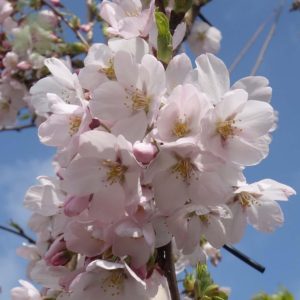
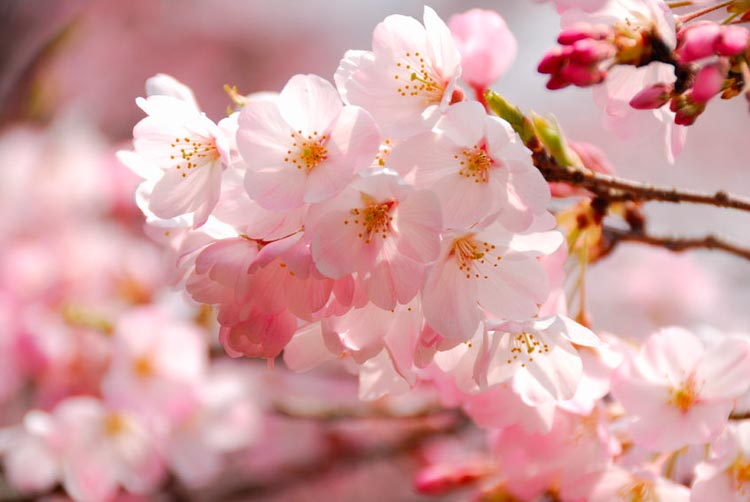
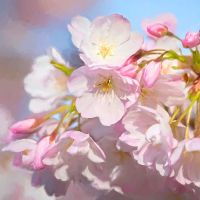
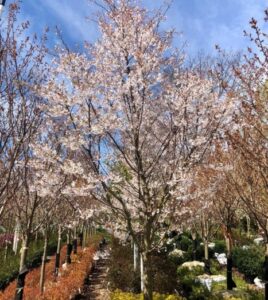
Akebono presents itself as a refined, gracefully spreading tree with a naturally vase-like form that grows wider than it is tall. The branches arch gently outward, creating an open, airy silhouette even when bare. In spring, before the leaves emerge, the tree becomes engulfed in delicate, pale pink single flowers that deepen slightly toward the center—a subtle color that manages to be both bold and understated. The blossoms are smaller and more refined than some of the double-flowered cherries, giving Akebono an almost pristine quality. The emerging foliage is a soft bronze-green, maturing to a medium green throughout summer, then turning a warm orange-bronze in fall before dropping.
Growing it in your garden
Akebono thrives throughout Connecticut and the greater New England region, handling our variable springs and occasional late freezes better than many other flowering cherries. Plant it in full sun—six hours minimum, though eight or more is ideal—where it’ll develop that characteristic full, spreading crown. The tree prefers well-draining soil and actually doesn’t like wet feet, so if you’re working with heavy clay, amend generously with compost before planting. Spring is the best planting time, giving the tree the entire growing season to establish before winter arrives. Don’t feel pressured to baby it; Akebono is genuinely tough and adaptable to Connecticut’s soil pH and climate challenges.
Through the seasons
Spring is, of course, Akebono’s shining moment. The flowers typically appear in mid-April, lasting roughly two weeks depending on whether we get one of those warmish springs or a lingering cool one. Even when frost threatens, these blossoms are surprisingly resilient. Summer is quieter—the tree provides dappled shade and a restful presence without demanding attention. Fall brings a warm, subtle color change; it’s not the blazing crimson of a sugar maple, but it’s a welcoming transition. Winter reveals the tree’s graceful branching structure, which is actually quite beautiful even when deciduous.
Where it shines
Akebono earns its place as a specimen tree—plant it where you can see it clearly, perhaps as a focal point in your landscape or positioned to frame a view from your main living spaces. It’s equally at home anchoring a mixed border or standing alone in lawn. Because of its moderate spread and upright-spreading form, it fits nicely into suburban yards without overwhelming the space like some of the larger ornamental trees. The light, dappled shade it casts makes it perfect for underplanting with spring bulbs, shade-tolerant perennials, or woodland shade plants once they’re established.
Perfect companions
Pair Akebono with shade-tolerant spring bulbs like MUSCARI (grape hyacinth) and CHIONODOXA (glory of the snow) for continuous spring color. Evergreen shrubs like ILEX CRENATA (boxwood) and BUXUS species provide structural contrast and create a backdrop that makes the cherry’s form and flowers pop. In the shrub layer, consider VIBURNUM CARLESII for fragrance to complement the cherry’s visual show, or SARCOCOCCA for winter interest. The tree’s filtered shade supports perennials like hellebores, hostas, and epimedium once established.
Care tips
Water regularly during the first year to establish a strong root system, then Akebono is remarkably self-sufficient. Prune only when necessary—these trees naturally develop attractive form without heavy pruning. If you do prune, do it immediately after flowering while the tree is still in bloom cycle. Watch for the occasional Japanese beetle in summer (they’re not typically devastating), and keep an eye out for black knot fungus, though Akebono’s open branching generally provides good air circulation to prevent fungal issues. Fertilizing isn’t necessary in established trees; your spring leaf litter provides ample nutrition as it breaks down.
Quick facts
- Hardiness Zone: Zones 5-8
- Mature Height & Spread: 25-30 feet tall, 20-25 feet wide
- Bloom Season: Mid-April through May
- Light Requirements: Full sun (6+ hours daily)
- Water Needs: Moderate; prefers well-draining soil
- Available at: Both our retail and wholesale locations