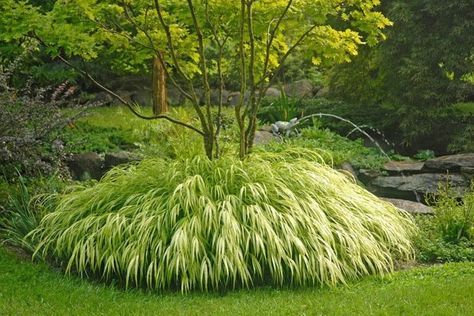
Aureola Japanese grass

HAKONECHLOA MACRA ‘AUREOLA’

If you’ve been searching for a plant that brings both movement and light to shady corners of your Connecticut garden, stop looking. HAKONECHLOA MACRA ‘AUREOLA’—commonly called Aureola Japanese grass—is the answer you didn’t know you needed. This delicate, cascading grass transforms ordinary spaces into something almost magical, with foliage that catches what little light filters through trees and seems to glow from within. It’s not just beautiful; it’s a game-changer for gardeners tired of struggling with typical shade plants.

What it looks like

Aureola is pure poetry in plant form. Impossibly fine, threadlike leaves in shades of golden yellow with green striping tumble downward in a graceful fountain of color. The foliage is so delicate it seems to float, moving gently with the slightest breeze. Unlike many ornamental grasses that feel sturdy and architectural, this one is soft, almost ethereal. In late summer and early fall, it sends up inconspicuous flowers—nothing showy, but they add a subtle textural layer. The colors shift slightly through the seasons, deepening as temperatures drop, adding visual interest year-round.

Growing it in your garden

Here’s what makes Aureola special for New England gardeners: it thrives in the exact conditions most other grasses resent. While its cousins demand full sun and well-drained soil, this Japanese native actually prefers partial to full shade and tolerates moisture beautifully. In fact, it performs exceptionally well in the damp, shadowy spots under deciduous trees—places where many plants struggle. It’s not fussy about soil type, though it appreciates something with decent organic matter. Plant it where you can enjoy the way it moves, perhaps near a window or along a path where you’ll catch the light dancing through those fine leaves.

Through the seasons

Spring arrives with fresh, bright growth that gradually becomes more golden as the season progresses. Summer is when Aureola truly shines in Connecticut gardens—while other plants wilt in humid conditions, this one stays fresh and luminous, providing cooling visual relief in shaded areas. Fall brings deepening coral and bronze tones to the foliage, a subtle but lovely shift. Winter presents a choice: you can cut back the dried foliage to the ground in late winter before new growth emerges, or leave it standing for architectural interest and to protect the crown. Either way, it’s completely winter-hardy in Connecticut, requiring no special protection.

Where it shines

Aureola earned its reputation as a shade garden superstar for good reason. Use it in Japanese-style gardens, woodland settings, and shaded borders where it becomes a focal point. It’s spectacular cascading over the edge of a raised bed or container where you can really appreciate the movement of the foliage. Along a north-facing foundation planting, under trees with dappled shade, or in moist areas where other ornamental grasses won’t survive—this is where Aureola transforms a problem spot into a garden highlight. It’s also remarkably effective in contemporary garden designs, bringing softness and motion to minimalist spaces.

Perfect companions

Aureola pairs beautifully with shade-loving hostas—plant it alongside HOSTA ‘Sum and Substance’ for a striking contrast of fine and bold textures. Japanese forest grasses, CAREX species, and shade ferns all make excellent companions. For flowering interest, consider pairing it with heuchera, coral bells, or astilbe. The delicate nature of Aureola works wonderfully with equally refined plants like HELLEBORUS niger (winter rose) and CONVALLARIA majalis (lily of the valley). Even simple companion plantings with shade groundcovers like VINCA minor create sophisticated combinations.

Care tips

Aureola asks very little of you. Water regularly the first season to establish a strong root system, then it becomes quite drought-tolerant despite its preference for moisture. In Connecticut’s humid summers, this plant thrives with minimal fussing. No staking needed, no frequent division necessary. Every few years (every three to four years is ideal), you can divide established plants in early spring if you want more for the garden. The only real maintenance is deciding whether to cut back the previous year’s growth in late winter or early spring. Fertilizing isn’t necessary if you’ve incorporated compost into the soil at planting time.

Quick facts

  • Hardiness Zone: Zones 5–9 (thrives throughout Connecticut)
  • Mature Height & Spread: 12–16 inches tall, 18–24 inches wide
  • Bloom Season: Late summer to early fall (flowers are inconspicuous)
  • Light Requirements: Partial to full shade
  • Water Needs: Moderate; prefers consistently moist soil but tolerates drier conditions once established
  • Available at: Both our retail and wholesale locations

Aureola Japanese grass

‘Aureola’ is a golden-striped form of Hakone grass. It is a rhizomatous, deciduous perennial grass that typically grows in dense spreading clumps to 15” tall and features gracefully arching green leaves variegated with gold longitudinal striping.

Description

Aureola Japanese grass

HAKONECHLOA MACRA ‘AUREOLA’

If you’ve been searching for a plant that brings both movement and light to shady corners of your Connecticut garden, stop looking. HAKONECHLOA MACRA ‘AUREOLA’—commonly called Aureola Japanese grass—is the answer you didn’t know you needed. This delicate, cascading grass transforms ordinary spaces into something almost magical, with foliage that catches what little light filters through trees and seems to glow from within. It’s not just beautiful; it’s a game-changer for gardeners tired of struggling with typical shade plants.

What it looks like

Aureola is pure poetry in plant form. Impossibly fine, threadlike leaves in shades of golden yellow with green striping tumble downward in a graceful fountain of color. The foliage is so delicate it seems to float, moving gently with the slightest breeze. Unlike many ornamental grasses that feel sturdy and architectural, this one is soft, almost ethereal. In late summer and early fall, it sends up inconspicuous flowers—nothing showy, but they add a subtle textural layer. The colors shift slightly through the seasons, deepening as temperatures drop, adding visual interest year-round.

Growing it in your garden

Here’s what makes Aureola special for New England gardeners: it thrives in the exact conditions most other grasses resent. While its cousins demand full sun and well-drained soil, this Japanese native actually prefers partial to full shade and tolerates moisture beautifully. In fact, it performs exceptionally well in the damp, shadowy spots under deciduous trees—places where many plants struggle. It’s not fussy about soil type, though it appreciates something with decent organic matter. Plant it where you can enjoy the way it moves, perhaps near a window or along a path where you’ll catch the light dancing through those fine leaves.

Through the seasons

Spring arrives with fresh, bright growth that gradually becomes more golden as the season progresses. Summer is when Aureola truly shines in Connecticut gardens—while other plants wilt in humid conditions, this one stays fresh and luminous, providing cooling visual relief in shaded areas. Fall brings deepening coral and bronze tones to the foliage, a subtle but lovely shift. Winter presents a choice: you can cut back the dried foliage to the ground in late winter before new growth emerges, or leave it standing for architectural interest and to protect the crown. Either way, it’s completely winter-hardy in Connecticut, requiring no special protection.

Where it shines

Aureola earned its reputation as a shade garden superstar for good reason. Use it in Japanese-style gardens, woodland settings, and shaded borders where it becomes a focal point. It’s spectacular cascading over the edge of a raised bed or container where you can really appreciate the movement of the foliage. Along a north-facing foundation planting, under trees with dappled shade, or in moist areas where other ornamental grasses won’t survive—this is where Aureola transforms a problem spot into a garden highlight. It’s also remarkably effective in contemporary garden designs, bringing softness and motion to minimalist spaces.

Perfect companions

Aureola pairs beautifully with shade-loving hostas—plant it alongside HOSTA ‘Sum and Substance’ for a striking contrast of fine and bold textures. Japanese forest grasses, CAREX species, and shade ferns all make excellent companions. For flowering interest, consider pairing it with heuchera, coral bells, or astilbe. The delicate nature of Aureola works wonderfully with equally refined plants like HELLEBORUS niger (winter rose) and CONVALLARIA majalis (lily of the valley). Even simple companion plantings with shade groundcovers like VINCA minor create sophisticated combinations.

Care tips

Aureola asks very little of you. Water regularly the first season to establish a strong root system, then it becomes quite drought-tolerant despite its preference for moisture. In Connecticut’s humid summers, this plant thrives with minimal fussing. No staking needed, no frequent division necessary. Every few years (every three to four years is ideal), you can divide established plants in early spring if you want more for the garden. The only real maintenance is deciding whether to cut back the previous year’s growth in late winter or early spring. Fertilizing isn’t necessary if you’ve incorporated compost into the soil at planting time.

Quick facts

  • Hardiness Zone: Zones 5–9 (thrives throughout Connecticut)
  • Mature Height & Spread: 12–16 inches tall, 18–24 inches wide
  • Bloom Season: Late summer to early fall (flowers are inconspicuous)
  • Light Requirements: Partial to full shade
  • Water Needs: Moderate; prefers consistently moist soil but tolerates drier conditions once established
  • Available at: Both our retail and wholesale locations