European Hornbeam

CARPINUS BETULUS

If you’ve been searching for a tree that brings European elegance to a Connecticut garden without demanding constant fussing, European Hornbeam might be exactly what you’ve been looking for. This is a tree that respects its gardener’s time while delivering year-round interest, from spring’s fresh green to autumn’s golden-bronze persistence. It’s the kind of plant that makes people stop and ask, “What is that beautiful tree?” — and then you get to tell them about one of Europe’s most refined deciduous treasures.

What it looks like

CARPINUS BETULUS is a study in understated elegance. The tree typically grows with a naturally pyramidal to oval form, dense with a fine-textured branching structure that’s particularly striking when bare. The leaves are small and delicately oval, deep green in summer with a subtle sheen that catches afternoon light beautifully. Come autumn, the foliage transforms into warm shades of golden-yellow and bronze — nothing explosive or dramatic, but rather a sophisticated, gradual shift that can persist well into November.

The bark deserves its own moment of appreciation: smooth and pale gray, it adds architectural interest even in winter. And there are flowers, though you might miss them if you’re not paying attention — delicate catkins emerge in spring, followed by unusual winged seeds enclosed in leafy bracts that flutter down like tiny hop-like clusters. These seed structures are genuinely charming once you notice them.

Growing it in your garden

European Hornbeam is remarkably adaptable, which is perhaps why it’s thrived throughout Europe for centuries and performs beautifully here in Connecticut. It prefers full sun to part shade — give it at least four hours of direct sunlight daily, and it’ll reward you with denser branching and more vibrant autumn color. Unlike some ornamental trees that demand perfection, this one tolerates a wide range of soil conditions. It appreciates soil that drains reasonably well, but once established, it’s fairly forgiving. It even handles clay better than many of its peers.

This tree actually benefits from regular moisture during its establishment phase (the first couple of years), so water consistently through the first growing season. After that, it becomes quite drought-tolerant once its root system develops. In New England, we don’t typically get the extended dry periods that stress many trees, so you’re working with favorable conditions here.

Through the seasons

Spring brings fresh, bright green leaves that unfurl with almost yellow undertones — absolutely luminous when backlit. Late spring shows those delicate catkins if you’re looking closely, adding a subtle botanical interest. Summer is all about that dense, refined canopy providing valuable shade without the heaviness some maples bring. The fine texture creates dappled light rather than a solid shadow, which is wonderful if you want to garden beneath the tree.

Autumn is when European Hornbeam truly shows its character. Rather than a dramatic color change, you get this prolonged, subtle shift to golden-bronze that seems to last weeks. Many leaves actually persist on the tree well into winter — a characteristic called marcescence — creating an airy, almost russet screen even after deciduous neighbors have gone completely bare. Winter silhouette is beautiful: the densely branched structure is perfectly proportioned and symmetrical.

Where it shines

This is an excellent choice as a specimen tree in a landscape where you want refined, sophisticated presence rather than seasonal fireworks. Its moderate mature size makes it suitable for residential properties where large oaks would eventually overwhelm the space. European Hornbeam works beautifully as a shade tree for patios or gardens, creating that dappled light environment perfect for shade-loving plants below.

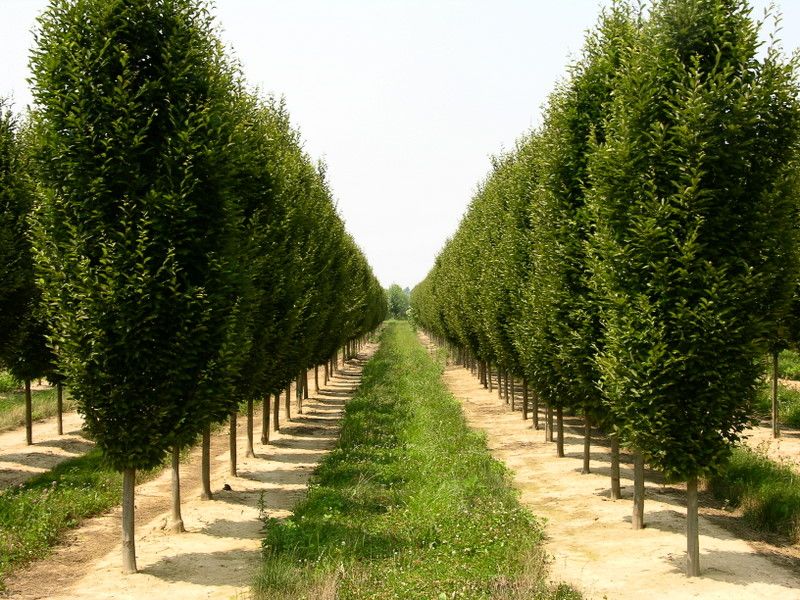
It’s also magnificent as part of a woodland edge or screen planting. Its naturally dense form means it provides genuine privacy without looking like a windbreak. If you’re interested in creating a more European-style garden or a formal landscape, CARPINUS BETULUS is absolutely at home. And in New England, where we appreciate trees that handle our climate without drama, this one is understated perfection.

Perfect companions

Pair European Hornbeam with shade-loving understory plantings: Hellebores, Epimedium, and woodland ferns thrive in the dappled shade it provides. Its refined character meshes beautifully with other European plants like Serviceberry and Redbud. For contrast in a mixed border, consider evergreens like boxwood or holly to play against its deciduous texture. Spring bulbs like Scilla and Chionodoxa look charming naturalizing beneath it.

Care tips

Pruning is rarely necessary — this tree naturally develops a balanced, attractive form. If you do need to shape it, do so in late winter while dormant. Avoid heavy pruning; light shaping to remove crossing branches is all you’ll typically need. Watch for scale insects in some years, but our Connecticut climate keeps most pests manageable. The tree has no significant disease issues in our region. Avoid compacting soil around the root zone, and you’ll have decades of beautiful growth ahead.

Quick facts

  • Hardiness Zone: Zones 4–7
  • Mature Height & Spread: 40–50 feet tall, 30–40 feet wide
  • Bloom Season: Spring catkins; winged seeds in late spring
  • Light Requirements: Full sun to part shade
  • Water Needs: Moderate; drought-tolerant once established
  • Available at: Both our retail and wholesale locations

European Hornbeam

A slow growing upright habit which is well suited as a specimen or street tree. Compact ascending branches creates an effective screen.

Zoning: 5-7
Mature Height and Spread: 30-35’ & 20-25’
Trunk Diameter: 2”, 2.5”, 3”, 3.5”, 4”+

Description

European Hornbeam

CARPINUS BETULUS

If you’ve been searching for a tree that brings European elegance to a Connecticut garden without demanding constant fussing, European Hornbeam might be exactly what you’ve been looking for. This is a tree that respects its gardener’s time while delivering year-round interest, from spring’s fresh green to autumn’s golden-bronze persistence. It’s the kind of plant that makes people stop and ask, “What is that beautiful tree?” — and then you get to tell them about one of Europe’s most refined deciduous treasures.

What it looks like

CARPINUS BETULUS is a study in understated elegance. The tree typically grows with a naturally pyramidal to oval form, dense with a fine-textured branching structure that’s particularly striking when bare. The leaves are small and delicately oval, deep green in summer with a subtle sheen that catches afternoon light beautifully. Come autumn, the foliage transforms into warm shades of golden-yellow and bronze — nothing explosive or dramatic, but rather a sophisticated, gradual shift that can persist well into November.

The bark deserves its own moment of appreciation: smooth and pale gray, it adds architectural interest even in winter. And there are flowers, though you might miss them if you’re not paying attention — delicate catkins emerge in spring, followed by unusual winged seeds enclosed in leafy bracts that flutter down like tiny hop-like clusters. These seed structures are genuinely charming once you notice them.

Growing it in your garden

European Hornbeam is remarkably adaptable, which is perhaps why it’s thrived throughout Europe for centuries and performs beautifully here in Connecticut. It prefers full sun to part shade — give it at least four hours of direct sunlight daily, and it’ll reward you with denser branching and more vibrant autumn color. Unlike some ornamental trees that demand perfection, this one tolerates a wide range of soil conditions. It appreciates soil that drains reasonably well, but once established, it’s fairly forgiving. It even handles clay better than many of its peers.

This tree actually benefits from regular moisture during its establishment phase (the first couple of years), so water consistently through the first growing season. After that, it becomes quite drought-tolerant once its root system develops. In New England, we don’t typically get the extended dry periods that stress many trees, so you’re working with favorable conditions here.

Through the seasons

Spring brings fresh, bright green leaves that unfurl with almost yellow undertones — absolutely luminous when backlit. Late spring shows those delicate catkins if you’re looking closely, adding a subtle botanical interest. Summer is all about that dense, refined canopy providing valuable shade without the heaviness some maples bring. The fine texture creates dappled light rather than a solid shadow, which is wonderful if you want to garden beneath the tree.

Autumn is when European Hornbeam truly shows its character. Rather than a dramatic color change, you get this prolonged, subtle shift to golden-bronze that seems to last weeks. Many leaves actually persist on the tree well into winter — a characteristic called marcescence — creating an airy, almost russet screen even after deciduous neighbors have gone completely bare. Winter silhouette is beautiful: the densely branched structure is perfectly proportioned and symmetrical.

Where it shines

This is an excellent choice as a specimen tree in a landscape where you want refined, sophisticated presence rather than seasonal fireworks. Its moderate mature size makes it suitable for residential properties where large oaks would eventually overwhelm the space. European Hornbeam works beautifully as a shade tree for patios or gardens, creating that dappled light environment perfect for shade-loving plants below.

It’s also magnificent as part of a woodland edge or screen planting. Its naturally dense form means it provides genuine privacy without looking like a windbreak. If you’re interested in creating a more European-style garden or a formal landscape, CARPINUS BETULUS is absolutely at home. And in New England, where we appreciate trees that handle our climate without drama, this one is understated perfection.

Perfect companions

Pair European Hornbeam with shade-loving understory plantings: Hellebores, Epimedium, and woodland ferns thrive in the dappled shade it provides. Its refined character meshes beautifully with other European plants like Serviceberry and Redbud. For contrast in a mixed border, consider evergreens like boxwood or holly to play against its deciduous texture. Spring bulbs like Scilla and Chionodoxa look charming naturalizing beneath it.

Care tips

Pruning is rarely necessary — this tree naturally develops a balanced, attractive form. If you do need to shape it, do so in late winter while dormant. Avoid heavy pruning; light shaping to remove crossing branches is all you’ll typically need. Watch for scale insects in some years, but our Connecticut climate keeps most pests manageable. The tree has no significant disease issues in our region. Avoid compacting soil around the root zone, and you’ll have decades of beautiful growth ahead.

Quick facts

  • Hardiness Zone: Zones 4–7
  • Mature Height & Spread: 40–50 feet tall, 30–40 feet wide
  • Bloom Season: Spring catkins; winged seeds in late spring
  • Light Requirements: Full sun to part shade
  • Water Needs: Moderate; drought-tolerant once established
  • Available at: Both our retail and wholesale locations