
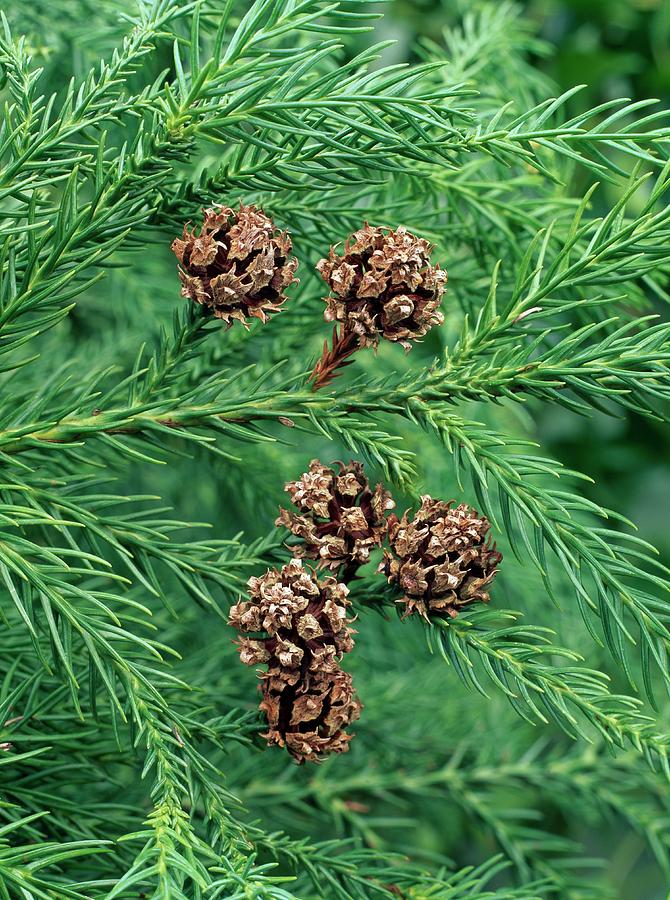
Description

CRYPTOMERIA JAPONICA
There’s something almost architectural about the Japanese Cedar—a tree that manages to be both impossibly graceful and boldly structural at the same time. If you’ve ever walked through a Japanese garden and felt that sense of deliberate elegance, you’ve likely stood beneath one of these. The good news? You can bring that same refined beauty to your Connecticut landscape, and CRYPTOMERIA JAPONICA grows surprisingly well in our New England climate.
What it looks like
Japanese Cedar is a narrowly pyramidal evergreen with a strikingly formal silhouette—the kind of tree that looks like it was hand-sculpted by someone with very particular taste. Its foliage is soft and feathery, composed of fine, scale-like needles that range from bright green in summer to copper-bronze or rust tones in winter. Some cultivars, like ‘Elegans,’ develop particularly dramatic color changes when temperatures drop, transitioning into deep burgundy and russet hues that persist through the coldest months. The bark is reddish-brown, fibrous, and peeling—quite ornamental in its own right, especially on older specimens. This tree has presence. It doesn’t whisper; it speaks in a clear, confident voice.
Growing it in your garden
Japanese Cedar prefers full sun to partial shade—give it at least six hours of direct sunlight daily for best color development and form. It wants well-draining soil that’s slightly acidic, the kind of conditions that mimic the forest floors of its native Japan. The good news is that most Connecticut soils lean toward the acidic side naturally, so you’re probably already halfway there. This tree is not drought-tolerant, so consistent moisture is important, especially during its first few years of establishment. It doesn’t love wet feet either; aim for that Goldilocks zone of evenly moist but well-draining soil. Wind can be an issue in exposed locations—these trees are somewhat brittle, so shelter them from harsh winter winds if possible.
Through the seasons
Spring arrives with the appearance of tiny, delicate new growth that catches the light beautifully. Summer showcases the full glory of its feathery green foliage, that soft texture that invites you to reach out and touch it (and you should—it’s lovely). Fall is when some cultivars truly shine, developing those warm bronze and copper tones that deepen as temperatures plummet. Winter is perhaps most striking: the Japanese Cedar in winter color is an entirely different experience, looking almost sculptural in frost or snow, those rust and burgundy tones glowing against the gray Connecticut landscape. The overall architectural quality of the tree becomes even more apparent when deciduous trees nearby have dropped their leaves.
Where it shines
Use Japanese Cedar as a focal point in your landscape—a specimen tree that draws the eye and anchors a space with its formality. It’s stunning along a property line where you want to create visual interest and privacy without the heaviness of a typical dense screen. In a Japanese-inspired garden, it’s practically mandatory. It also works beautifully in foundation plantings where you need vertical interest, or in mixed evergreen borders where it provides a contrasting texture to broader-leaved plants. Consider placing it where its winter color can be appreciated against a lighter backdrop—say, in front of a white house or evergreen backdrop.
Perfect companions
Japanese Cedar pairs beautifully with understory plants that appreciate similar conditions. Plant it alongside Japanese Holly (ILEX CRENATA) for complementary textures, or with dwarf varieties of Hinoki Cypress (CHAMAECYPARIS OBTUSA) for a woodland feel. Shade-tolerant groundcovers like Japanese Forest Grass (HAKONECHLOA MACRA) create a soft carpet at its base. For contrast, consider nearby plantings of hostas or hellebores that appreciate the dappled shade this tree can provide as it matures. Deciduous companions like Japanese Maple (ACER PALMATUM) or Serviceberry (AMELANCHIER) create striking seasonal combinations.
Care tips
Young trees benefit from consistent watering through their first two growing seasons—don’t let them dry out. Prune only to remove dead or damaged branches; this tree has a naturally beautiful form that rarely needs significant intervention. In New England winters, young or newly planted trees can appreciate some protection from harsh drying winds. Mulch around the base to keep soil consistently moist and moderate soil temperatures. Unlike some evergreens, Japanese Cedar doesn’t need heavy pruning to maintain its shape. If you do see any dead wood, remove it promptly, as this tree can be susceptible to canker issues in overly wet conditions.
Quick facts
- Hardiness Zone: Zones 4-8 (best in Zones 5-7 for New England)
- Mature Height & Spread: 40-60 feet tall, 20-30 feet wide (varies by cultivar)
- Bloom Season: Non-flowering; ornamental for foliage and form
- Light Requirements: Full sun to partial shade
- Water Needs: Consistently moist, well-draining soil; moderate to regular water
- Available at: Both our retail and wholesale locations