
Description

RHUS AROMATICA ‘GRO-LOW’
If you’ve been searching for something that handles wet soil, deep shade, and Connecticut winters without complaint, while also spreading across those difficult slopes and erosion-prone banks with absolute confidence—meet your new garden solution. Gro-Low Sumac is the kind of plant that quietly does everything right without demanding a shred of attention. It’s native vigor wrapped in an exceptionally tidy package, with a work ethic that honestly puts other groundcovers to shame.
What it looks like
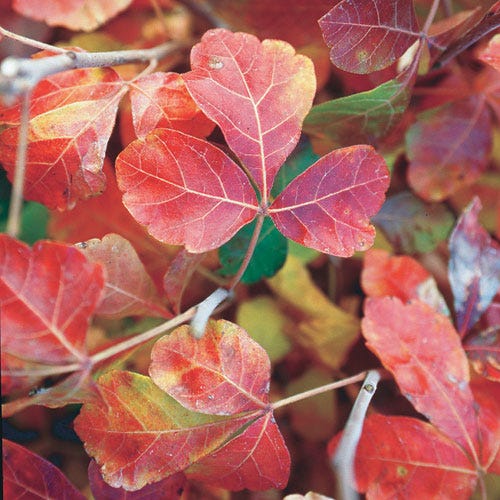
Gro-Low Sumac is a low, spreading shrub that rarely exceeds two feet in height, making it perfect for those awkward spaces where most plants either tower too tall or sprawl too wide. The foliage is delicate and finely textured—feathery compound leaves that catch light beautifully in spring and summer. But here’s where it gets interesting: in autumn, those airy green leaves transform into shades of orange, red, and deep burgundy that rival any maple. The effect is almost ethereal, like watching sunset happen across your entire groundcover layer. Small, greenish-yellow flowers appear in spring, followed by tiny red berries that persist into winter, adding visual interest and feeding local wildlife when food is scarce.
Growing it in your garden
This is where Gro-Low truly earns its reputation as a workhorse. It’s unfussy about soil type—actually thrives in poor, sandy, or compacted earth where other plants would simply give up. It tolerates dry conditions beautifully, making it excellent for New England gardens where summer drought is increasingly common. Unlike its taller relatives, this cultivar doesn’t sucker aggressively, so you won’t spend summers managing unwanted shoots. It spreads steadily through underground rhizomes, creating a dense, uniform mat that effectively chokes out weeds. Plant it on steep slopes, in parking lot islands, along driveways, or in any transitional space where you need dependable coverage. It’s equally at home in full sun or partial shade, though the autumn color intensifies with more sunlight.
Through the seasons
Spring brings fresh, bright green foliage with delicate new growth and those subtle greenish flowers that, while not showy, support early pollinators. Summer is when Gro-Low settles into reliable, textured greenery—the kind of consistent backdrop that makes other plants look better. Fall is the real show-stopper, with that remarkable color transformation happening reliably year after year in Connecticut’s cool autumn nights. Winter reveals its structure beautifully: the persistent red berries glow against snow, and the bare branches create interesting line and form. The plant is fully deciduous but tough as nails through our coldest winters.
Where it shines
This is essentially the plant you reach for when you’ve exhausted other options or need something truly low-maintenance. Steep banks that are a nightmare to mow? Gro-Low is your answer. Compacted soil around new construction? It actually improves the soil while establishing itself. That dry, shady corner under mature trees? It’ll spread contentedly. It’s also wonderful for wildlife areas—the berries feed birds and small mammals through late fall and winter. Container gardeners appreciate it too, though it eventually outgrows most pots. In Connecticut gardens, it’s becoming increasingly popular for ecological landscaping and pollinator-friendly designs.
Perfect companions
Gro-Low works beautifully with other native New England plants. Pair it with taller evergreens like ILEX VERTICILLATA (winterberry holly) for winter structure. Mix it with sedges and native grasses like CAREX pensylvanica for layered texture. It’s wonderful weaving through native asters and RUDBECKIA, where its fine texture contrasts with bolder flowers. Consider combining it with JUNIPERUS horizontalis (creeping juniper) for year-round color variation. For wildlife value, underscore it with native wildflowers that bloom when Gro-Low is transitioning seasons.
Care tips
Once established, this plant barely requires maintenance. Water during the first growing season to help roots establish, then it’s essentially on its own. It doesn’t need fertilization—actually prefers lean conditions. No pruning necessary, though you can lightly shear it in early spring if you want to encourage a more compact form. It has virtually no pest or disease issues in Connecticut. If you’re using it for erosion control on slopes, plant at tighter spacing for faster coverage. That’s really it. This is a plant that frees up your time for other garden projects.
Quick facts
- Hardiness Zone: 3-9 (perfectly hardy throughout Connecticut)
- Mature Height & Spread: 1-2 feet tall, spreading 4-6 feet wide
- Bloom Season: Spring (small, greenish flowers)
- Light Requirements: Full sun to partial shade
- Water Needs: Low to moderate; drought-tolerant once established
- Available at: Both our retail and wholesale locations