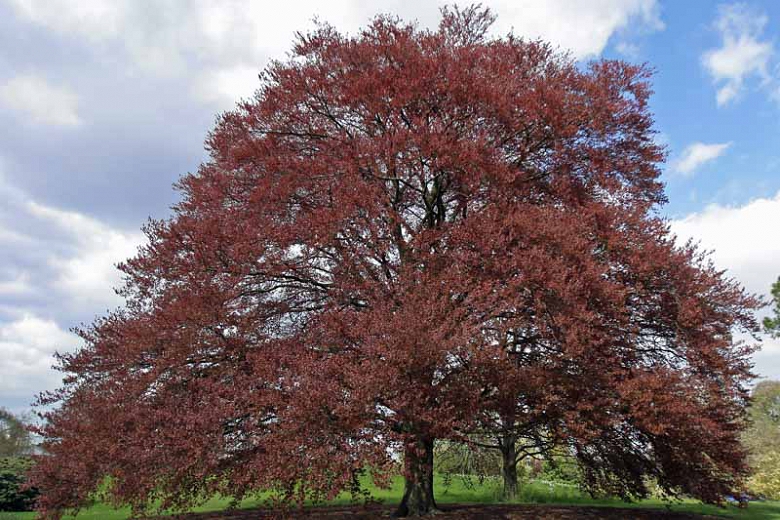
Purple European Beech

FAGUS SYLVATICA ‘PURPUREA’

If you’ve ever driven through the English countryside and been stopped cold by a massive tree with deep purple foliage that seems to glow in the afternoon light, you’ve met the Purple European Beech. This isn’t just another shade tree—it’s a living sculpture that transforms a garden into something deliberately, unmistakably special. In Connecticut gardens, where so many trees blur together by midsummer, a mature Purple Beech commands attention like nothing else. It’s the kind of tree that makes neighbors ask questions and guests comment on your “unusual” landscape design.

What it looks like

The Purple European Beech presents itself with architectural elegance. Smooth gray bark—almost muscular in appearance—supports a dense, pyramidal crown that becomes increasingly rounded with age. The real magic happens in the canopy: leaves emerge bright reddish-purple in spring, deepening to a rich, wine-dark purple through summer. In fall, before dropping, they turn an almost bronze-copper shade that catches afternoon sun like molten metal. The overall effect is moody and sophisticated, a tree that photographs beautifully and looks equally striking from every angle.

Growing it in your garden

Plant your Purple Beech in a location with full sun to light shade—the deeper the shade, the less vibrant the purple coloring. It prefers well-draining soil and doesn’t appreciate wet feet, so avoid low-lying areas where Connecticut’s spring snowmelt tends to settle. Once established, this tree is remarkably self-sufficient and handles our New England winters without flinching. Give it room to spread; these beeches eventually create dense canopies that provide lovely dappled shade beneath, though the dense leaf coverage means little grows directly underneath. They’re not particularly fussy about soil pH, though slightly acidic conditions support stronger color development.

Through the seasons

Spring brings that unmistakable flush of new growth—wine-red leaves unfurling against increasingly green surroundings. By early summer, the tree has settled into its deep purple persona, providing dramatic contrast to silver-leaved companions and sunny perennials. The foliage remains consistent and color-stable throughout the growing season, never fading to muddy green like some purple-leafed plants. Fall transforms it again; the leaves shift to russet and bronze tones that feel warmer than the summer purple. Even in winter, the elegant branching structure and refined gray bark provide architectural interest to the dormant Connecticut landscape.

Where it shines

This is your statement tree. Use it as a specimen planting where it can be admired from multiple angles—perhaps anchoring a lawn or serving as a focal point when viewed from your house. It creates stunning contrast in mixed borders, the deep purple making lighter colors pop and creating sophisticated color combinations with silver-leaved shrubs, burgundy Japanese maples, or golden conifers. In a hedge setting (yes, it takes beautifully to pruning), Purple Beech creates an incredibly refined formal screen. It also works well at the edge of woodlands, where it seems to bridge the gap between cultivated garden and wild landscape.

Perfect companions

The deep purple foliage creates incredible backdrop opportunities. Pair it with white-flowering hydrangeas, silver-leafed artemisia, or variegated hostas for maximum contrast. Golden conifers like CHAMAECYPARIS LAWSONIANA ‘ELWOOD’S GOLD’ or THUJA OCCIDENTALIS ‘DEGROOT’S SPIRE’ make the purple sing. For ground-level interest, consider shade-tolerant perennials with bright foliage like HEUCHERA or Japanese painted ferns. It plays beautifully with other trees too—a purple beech paired with a white-barked birch or silver maple creates visual magic. Underplant with shade-tolerant spring bulbs like hellebores that bloom before the dense summer canopy cuts off light.

Care tips

Water regularly during the first two growing seasons to establish a strong root system. Once mature, the Purple Beech is drought-tolerant, though it appreciates consistent moisture during Connecticut’s hot, dry summers. Pruning is rarely necessary except to remove dead wood or maintain shape—and honestly, this tree looks best with minimal interference. Beech scale and beech bark disease can occasionally affect beech trees in the Northeast, but our cold New England winters actually help keep pest and disease pressure lower than in warmer regions. If you notice unusual canker development or insect damage, contact a certified arborist. Mulch the base generously, but keep mulch a few inches away from the trunk.

Quick facts

  • Hardiness Zone: 4-7 (performs beautifully throughout Connecticut)
  • Mature Height & Spread: 40-60 feet tall, 30-40 feet wide
  • Bloom Season: Spring catkins (flowers are inconspicuous; grown for foliage)
  • Light Requirements: Full sun to light shade
  • Water Needs: Moderate; prefers well-draining soil
  • Available at: Both our retail and wholesale locations

Purple European Beech

Fagus sylvatica ‘Atropunicea’ is a tree with a spreading oval to round crown. It can attain a height and a spread of 25 – 30 m. The smooth bark is soft and has a grey colour. The oval to ovate leaf unfolds deep red and may turn to an intense brown red in autumn. Size 4 – 9 cm. Seedlings of this brown beech have various colours

Pot Size (gallons), Height: 6-8′

Description

Purple European Beech

FAGUS SYLVATICA ‘PURPUREA’

If you’ve ever driven through the English countryside and been stopped cold by a massive tree with deep purple foliage that seems to glow in the afternoon light, you’ve met the Purple European Beech. This isn’t just another shade tree—it’s a living sculpture that transforms a garden into something deliberately, unmistakably special. In Connecticut gardens, where so many trees blur together by midsummer, a mature Purple Beech commands attention like nothing else. It’s the kind of tree that makes neighbors ask questions and guests comment on your “unusual” landscape design.

What it looks like

The Purple European Beech presents itself with architectural elegance. Smooth gray bark—almost muscular in appearance—supports a dense, pyramidal crown that becomes increasingly rounded with age. The real magic happens in the canopy: leaves emerge bright reddish-purple in spring, deepening to a rich, wine-dark purple through summer. In fall, before dropping, they turn an almost bronze-copper shade that catches afternoon sun like molten metal. The overall effect is moody and sophisticated, a tree that photographs beautifully and looks equally striking from every angle.

Growing it in your garden

Plant your Purple Beech in a location with full sun to light shade—the deeper the shade, the less vibrant the purple coloring. It prefers well-draining soil and doesn’t appreciate wet feet, so avoid low-lying areas where Connecticut’s spring snowmelt tends to settle. Once established, this tree is remarkably self-sufficient and handles our New England winters without flinching. Give it room to spread; these beeches eventually create dense canopies that provide lovely dappled shade beneath, though the dense leaf coverage means little grows directly underneath. They’re not particularly fussy about soil pH, though slightly acidic conditions support stronger color development.

Through the seasons

Spring brings that unmistakable flush of new growth—wine-red leaves unfurling against increasingly green surroundings. By early summer, the tree has settled into its deep purple persona, providing dramatic contrast to silver-leaved companions and sunny perennials. The foliage remains consistent and color-stable throughout the growing season, never fading to muddy green like some purple-leafed plants. Fall transforms it again; the leaves shift to russet and bronze tones that feel warmer than the summer purple. Even in winter, the elegant branching structure and refined gray bark provide architectural interest to the dormant Connecticut landscape.

Where it shines

This is your statement tree. Use it as a specimen planting where it can be admired from multiple angles—perhaps anchoring a lawn or serving as a focal point when viewed from your house. It creates stunning contrast in mixed borders, the deep purple making lighter colors pop and creating sophisticated color combinations with silver-leaved shrubs, burgundy Japanese maples, or golden conifers. In a hedge setting (yes, it takes beautifully to pruning), Purple Beech creates an incredibly refined formal screen. It also works well at the edge of woodlands, where it seems to bridge the gap between cultivated garden and wild landscape.

Perfect companions

The deep purple foliage creates incredible backdrop opportunities. Pair it with white-flowering hydrangeas, silver-leafed artemisia, or variegated hostas for maximum contrast. Golden conifers like CHAMAECYPARIS LAWSONIANA ‘ELWOOD’S GOLD’ or THUJA OCCIDENTALIS ‘DEGROOT’S SPIRE’ make the purple sing. For ground-level interest, consider shade-tolerant perennials with bright foliage like HEUCHERA or Japanese painted ferns. It plays beautifully with other trees too—a purple beech paired with a white-barked birch or silver maple creates visual magic. Underplant with shade-tolerant spring bulbs like hellebores that bloom before the dense summer canopy cuts off light.

Care tips

Water regularly during the first two growing seasons to establish a strong root system. Once mature, the Purple Beech is drought-tolerant, though it appreciates consistent moisture during Connecticut’s hot, dry summers. Pruning is rarely necessary except to remove dead wood or maintain shape—and honestly, this tree looks best with minimal interference. Beech scale and beech bark disease can occasionally affect beech trees in the Northeast, but our cold New England winters actually help keep pest and disease pressure lower than in warmer regions. If you notice unusual canker development or insect damage, contact a certified arborist. Mulch the base generously, but keep mulch a few inches away from the trunk.

Quick facts

  • Hardiness Zone: 4-7 (performs beautifully throughout Connecticut)
  • Mature Height & Spread: 40-60 feet tall, 30-40 feet wide
  • Bloom Season: Spring catkins (flowers are inconspicuous; grown for foliage)
  • Light Requirements: Full sun to light shade
  • Water Needs: Moderate; prefers well-draining soil
  • Available at: Both our retail and wholesale locations