Description
MAGNOLIA GRANDIFLORA
There’s something undeniably romantic about Southern Magnolia. Perhaps it’s the way those enormous, creamy-white flowers open like silk handkerchiefs against deep green foliage, or maybe it’s the spicy-sweet fragrance that fills the air each late spring. Or maybe it’s simply the fact that you’re growing a tree with such Southern charm right here in Connecticut, defying expectations and adding that touch of elegant drama to your landscape. If you’ve ever driven beneath an avenue of magnolias in full bloom, you understand the spell they cast. Now you can create that magic in your own garden.
What it looks like
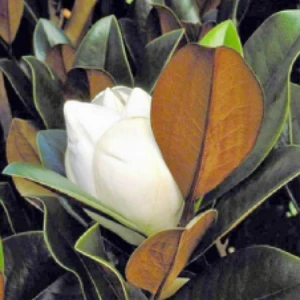
MAGNOLIA GRANDIFLORA is an evergreen broadleaf tree that carries an almost architectural presence in the landscape. The glossy, deep green leaves are substantial and handsome year-round, with a distinctive reddish-brown fuzzy underside that’s quite striking if you’re positioned to see it. Those flowers—oh, those flowers—are genuinely enormous, reaching 6 to 8 inches across. They’re creamy white with a pale yellow center, appearing in clusters throughout late spring and early summer. The tree grows into a pyramidal or conical shape with dense branching, eventually reaching considerable height and spread. Even in winter, the evergreen foliage provides structure and screening that deciduous trees can’t match.
Growing it in your garden
Here’s where Southern Magnolia surprises Connecticut gardeners: it’s tougher than you’d think. Yes, it’s native to the Deep South, but cultivars like ‘Brackens Brown Beauty’ and ‘Teddy Bear’ have been carefully selected for cold hardiness. They’ll thrive in Zones 6 and 7 with proper placement. The key is giving yours a sheltered spot—ideally where it’s protected from harsh winter winds and has afternoon shade in summer. Think of a location on the east or southeast side of your home, or beneath the dappled shade of a larger tree canopy. Morning sun exposure helps. Soil-wise, MAGNOLIA GRANDIFLORA prefers slightly acidic, well-draining soil rich in organic matter. If your Connecticut garden has neutral or alkaline soil, amend it generously with compost and peat moss before planting. Plant in spring so the tree has time to establish itself before winter arrives.
Through the seasons
Spring is the magnolia’s moment of glory. As temperatures warm in late May and June, those magnificent flowers emerge, perfuming your entire garden and drawing admiring glances from everyone who passes by. The blooms are followed by interesting cone-like seed pods that persist into fall and add architectural interest to the tree. Summer finds the glossy foliage providing cool, dark shade and a lush tropical appearance that seems impossibly out of place in New England—in the best way possible. Fall in Connecticut means most trees are changing, but your magnolia remains steadfastly evergreen, maintaining that deep green presence. This evergreen quality is invaluable in winter, when the tree becomes a visual anchor in the landscape. Those glossy leaves shed snow gracefully, and the tree’s strong branching structure is fully visible without leaf cover.
Where it shines
Southern Magnolia is a statement plant, so placement matters. Use it as a specimen tree where you want all eyes to focus, perhaps at the end of a long sight line or anchoring a corner of your home. Its evergreen foliage makes it excellent for year-round screening and privacy. Many Connecticut gardeners use it to soften the harsh lines of modern architecture or to create a backdrop for a perennial border. It performs beautifully in foundation plantings on larger homes, where its mature size won’t overwhelm the space. In more formal gardens, it adds sophistication; in cottage settings, it brings unexpected elegance. If you’re creating a sanctuary garden where you want to sit surrounded by fragrance and beauty in late spring, there’s simply no better choice.
Perfect companions
Plant MAGNOLIA GRANDIFLORA with understory shade lovers that won’t compete with it. Creeping Phlox, Hellebores, and shade-tolerant Hostas look lovely beneath and around it. Evergreen shrubs like Boxwood, Japanese Holly, and Leatherleaf Viburnum echo its year-round presence without stealing its thunder. Pair it with spring bulbs—Daffodils and Hyacinths—for earlier seasonal interest. Ornamental grasses like Carex nearby add movement and delicate texture. These companions fill in the space while letting your magnolia remain the undisputed star.
Care tips
Newly planted magnolias need consistent moisture through their first growing season—think of it as an investment in establishment. Once settled, they’re reasonably drought-tolerant. Mulch around the base with 2 to 3 inches of wood chips, keeping it a few inches away from the trunk. Prune only to remove dead wood or shape growth; magnolias don’t appreciate heavy pruning. In Connecticut, protect young trees from harsh winter winds with burlap wrapping if necessary. Feed in early spring with a balanced, slow-release fertilizer formulated for broadleaf evergreens. Watch for scale insects in summer—a horticultural oil spray usually handles them quickly.
Quick facts
- Hardiness Zone: 6-7 (cultivar dependent)
- Mature Height & Spread: 25-35 feet tall, 15-20 feet wide (varies by cultivar)
- Bloom Season: Late May through June
- Light Requirements: Full sun to part shade (afternoon shade in hotter climates)
- Water Needs: Moderate; consistent moisture while establishing, then drought-tolerant
- Available at: Both our retail and wholesale locations.