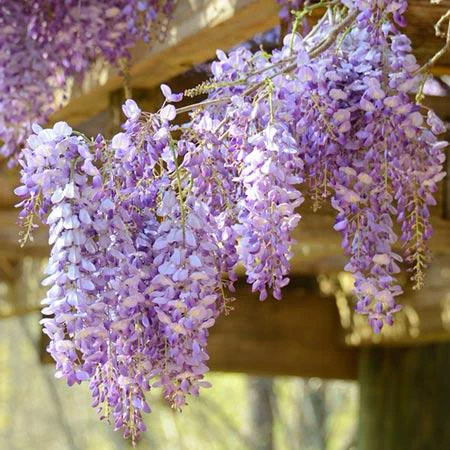
WISTERIA FRUTESCENS

If you’ve been captivated by those dreamy wisteria-covered pergolas in magazines but worried about the aggressive Asian varieties taking over your Connecticut garden, native Purple Wisteria is your answer. This is the well-behaved cousin that still delivers all the romance without the botanical chaos. Elegant, fragrant, and genuinely happy in New England conditions, WISTERIA FRUTESCENS grows at a manageable pace while rewarding you with cascades of purple blooms that seem to float like lavender waterfalls along your structures.

What it looks like

Purple Wisteria is a deciduous woody vine with a refined, almost delicate appearance despite its vigor. The foliage emerges a fresh green in spring, developing into compound leaves arranged alternately along the stems—they’re feathery and fine-textured, creating a soft, filtered effect even when fully leafed out. Come mid-summer, the show begins: clusters of small, sweet pea-like flowers in a dusty purple-blue unfurl in loose, elongated racemes. Unlike the dense flower chains of Asian wisteria, our native version offers a lighter, more airy floral presentation that somehow feels even more charming. The flowers release an intoxicating fragrance that carries on warm June breezes. By fall, the foliage turns a soft golden-yellow before dropping, revealing the attractive woody structure of mature vines.

Growing it in your garden

This is where Purple Wisteria shines for Connecticut gardeners. It’s not going to wrap itself around your gutters, strangle your trees, or send runners under your foundation like its Asian cousins. WISTERIA FRUTESCENS grows at a moderate, controllable pace—usually reaching 15 to 20 feet with regular pruning, but content to stay smaller if that’s what your space demands. Plant it where it can climb a sturdy arbor, pergola, fence, or trellis; give it something substantial to hold onto. The vine becomes woody and substantial over time, so those supports need to be built to last.

In terms of location, think sun-loving. Purple Wisteria wants at least six hours of direct sunlight daily to really perform its best—that’s when you’ll get the most abundant flowers and that intoxicating fragrance. It can tolerate partial shade, but your bloom show will be less spectacular. Give it room to sprawl and don’t crowd it against a wall where air circulation suffers.

Through the seasons

Spring brings vigorous new growth and those delicate, finely-textured leaves that emerge in a fresh, lime-tinged green. Early summer is peak season when the purple flowers appear—typically starting in June and often continuing into July, a timeline that works beautifully with Connecticut’s growing season. The fragrance is strongest on warm afternoons, particularly if you’ve had warm nights. Foliage holds strong through summer and into early fall, then transforms into golden-yellow tones before dropping. Winter reveals the architectural bones of the vine—the twisted, woody structure becomes a design element in itself, adding texture to your winter landscape.

Where it shines

Purple Wisteria is the perfect choice for arbors over patios or seating areas where you’ll actually experience that fragrance up close. It’s wonderful along fence lines where you want living coverage without concern about it colonizing the entire neighborhood. This vine works beautifully on pergolas attached to houses, rambling along the framework to create dappled shade without the aggressive nature of Asian varieties. It’s also surprisingly effective on mailbox posts or entrance arbors—any structure where you want that romantic, established look without the maintenance headaches of more vigorous vines. Native plant enthusiasts particularly love it because it supports our regional pollinators without the invasive concerns of non-native species.

Perfect companions

Underplant your wisteria with shade-tolerant perennials like HELLEBORUS or HOSTA to create visual interest at ground level while the vine does its work overhead. Clematis varieties can share the same structure—choose ones that bloom at different times to extend your flowering season. Climbing hydrangeas work beautifully alongside wisteria, their white lacecap flowers creating contrast to the purple blooms. For seasonal interest at the base, consider shade-loving shrubs like OAKLEAF HYDRANGEA or NATIVE SPICEBUSH.

Care tips

Pruning is your main tool for keeping Purple Wisteria looking its best and blooming prolifically. In late winter, cut back the previous season’s growth to two or three buds, creating a spur system. This encourages more flower buds and keeps the vine tidy. During the growing season, prune away any growth venturing where it shouldn’t go. Unlike Asian wisteria, this native isn’t going to punish you if you miss a pruning session, but regular attention will reward you with more consistent blooming.

Water regularly during the first year while the vine establishes itself, particularly during Connecticut’s dry spells. Once established, it’s quite self-sufficient, though consistent moisture produces better flowering. Avoid overly rich soil, which encourages vegetative growth at the expense of flowers; average garden soil is perfect. No serious pests or diseases typically plague native Purple Wisteria in New England gardens.

Quick facts

  • Hardiness Zone: Zones 5-9 (perfectly winter-hardy throughout Connecticut)
  • Mature Height & Spread: 15-20 feet with regular pruning (or keep smaller with maintenance)
  • Bloom Season: June-July
  • Light Requirements: Full sun to partial shade (best flowering in full sun)
  • Water Needs: Moderate; establish with regular water, then quite drought-tolerant
  • Available at: Both our retail and wholesale locations

Native Purple Wisteria

Category:

Wisteria has a bit of a reputation — and if you’ve ever seen an Asian wisteria eat a pergola, swallow a shed, and strangle a century-old oak tree, you understand why. But here’s the secret the gardeni…

Description

WISTERIA FRUTESCENS

If you’ve been captivated by those dreamy wisteria-covered pergolas in magazines but worried about the aggressive Asian varieties taking over your Connecticut garden, native Purple Wisteria is your answer. This is the well-behaved cousin that still delivers all the romance without the botanical chaos. Elegant, fragrant, and genuinely happy in New England conditions, WISTERIA FRUTESCENS grows at a manageable pace while rewarding you with cascades of purple blooms that seem to float like lavender waterfalls along your structures.

What it looks like

Purple Wisteria is a deciduous woody vine with a refined, almost delicate appearance despite its vigor. The foliage emerges a fresh green in spring, developing into compound leaves arranged alternately along the stems—they’re feathery and fine-textured, creating a soft, filtered effect even when fully leafed out. Come mid-summer, the show begins: clusters of small, sweet pea-like flowers in a dusty purple-blue unfurl in loose, elongated racemes. Unlike the dense flower chains of Asian wisteria, our native version offers a lighter, more airy floral presentation that somehow feels even more charming. The flowers release an intoxicating fragrance that carries on warm June breezes. By fall, the foliage turns a soft golden-yellow before dropping, revealing the attractive woody structure of mature vines.

Growing it in your garden

This is where Purple Wisteria shines for Connecticut gardeners. It’s not going to wrap itself around your gutters, strangle your trees, or send runners under your foundation like its Asian cousins. WISTERIA FRUTESCENS grows at a moderate, controllable pace—usually reaching 15 to 20 feet with regular pruning, but content to stay smaller if that’s what your space demands. Plant it where it can climb a sturdy arbor, pergola, fence, or trellis; give it something substantial to hold onto. The vine becomes woody and substantial over time, so those supports need to be built to last.

In terms of location, think sun-loving. Purple Wisteria wants at least six hours of direct sunlight daily to really perform its best—that’s when you’ll get the most abundant flowers and that intoxicating fragrance. It can tolerate partial shade, but your bloom show will be less spectacular. Give it room to sprawl and don’t crowd it against a wall where air circulation suffers.

Through the seasons

Spring brings vigorous new growth and those delicate, finely-textured leaves that emerge in a fresh, lime-tinged green. Early summer is peak season when the purple flowers appear—typically starting in June and often continuing into July, a timeline that works beautifully with Connecticut’s growing season. The fragrance is strongest on warm afternoons, particularly if you’ve had warm nights. Foliage holds strong through summer and into early fall, then transforms into golden-yellow tones before dropping. Winter reveals the architectural bones of the vine—the twisted, woody structure becomes a design element in itself, adding texture to your winter landscape.

Where it shines

Purple Wisteria is the perfect choice for arbors over patios or seating areas where you’ll actually experience that fragrance up close. It’s wonderful along fence lines where you want living coverage without concern about it colonizing the entire neighborhood. This vine works beautifully on pergolas attached to houses, rambling along the framework to create dappled shade without the aggressive nature of Asian varieties. It’s also surprisingly effective on mailbox posts or entrance arbors—any structure where you want that romantic, established look without the maintenance headaches of more vigorous vines. Native plant enthusiasts particularly love it because it supports our regional pollinators without the invasive concerns of non-native species.

Perfect companions

Underplant your wisteria with shade-tolerant perennials like HELLEBORUS or HOSTA to create visual interest at ground level while the vine does its work overhead. Clematis varieties can share the same structure—choose ones that bloom at different times to extend your flowering season. Climbing hydrangeas work beautifully alongside wisteria, their white lacecap flowers creating contrast to the purple blooms. For seasonal interest at the base, consider shade-loving shrubs like OAKLEAF HYDRANGEA or NATIVE SPICEBUSH.

Care tips

Pruning is your main tool for keeping Purple Wisteria looking its best and blooming prolifically. In late winter, cut back the previous season’s growth to two or three buds, creating a spur system. This encourages more flower buds and keeps the vine tidy. During the growing season, prune away any growth venturing where it shouldn’t go. Unlike Asian wisteria, this native isn’t going to punish you if you miss a pruning session, but regular attention will reward you with more consistent blooming.

Water regularly during the first year while the vine establishes itself, particularly during Connecticut’s dry spells. Once established, it’s quite self-sufficient, though consistent moisture produces better flowering. Avoid overly rich soil, which encourages vegetative growth at the expense of flowers; average garden soil is perfect. No serious pests or diseases typically plague native Purple Wisteria in New England gardens.

Quick facts

  • Hardiness Zone: Zones 5-9 (perfectly winter-hardy throughout Connecticut)
  • Mature Height & Spread: 15-20 feet with regular pruning (or keep smaller with maintenance)
  • Bloom Season: June-July
  • Light Requirements: Full sun to partial shade (best flowering in full sun)
  • Water Needs: Moderate; establish with regular water, then quite drought-tolerant
  • Available at: Both our retail and wholesale locations