GLEDITSIA TRIACANTHOS VAR. INERMIS

If you’ve been searching for a tree that gives you the best of both worlds—delicate, feathery foliage that lets dappled light through to your understory plantings, combined with sturdy, trouble-free growth—the Honey Locust might just be your answer. This native beauty brings an elegant, almost fern-like quality to the landscape while asking remarkably little in return. In Connecticut gardens, it’s the tree that works harder than it looks.

What it looks like

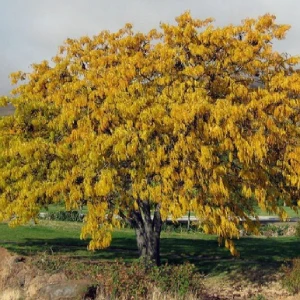
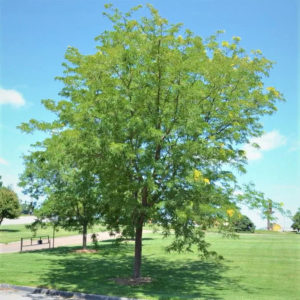
The Honey Locust is a deciduous tree with a naturally open, spreading form that develops into a vase-like or broad-crowned silhouette as it matures. Its most distinctive feature is its foliage: compound leaves that are twice pinnate (meaning they’re divided into smaller leaflets, which are themselves divided again), creating an airy, almost lacy appearance. In spring and summer, this fine-textured canopy appears almost ethereal, filtering sunlight in a way that dense-leafed trees simply cannot match.

The trunk and branches have an attractive gray color, becoming more ornamentally interesting as the tree ages. Tiny, inconspicuous greenish flowers appear in late spring, followed by long, flat seed pods that develop as the season progresses—these can be quite showy and add another layer of visual interest into fall.

Growing it in your garden

This is where the Honey Locust earns its reputation as a workhorse tree. It’s remarkably adaptable to Connecticut’s challenging soils and climate. It tolerates poor, compacted, or even alkaline soil with grace—sites where other trees would struggle. It handles salt exposure well, making it an excellent choice near driveways and roads. Once established, it’s impressively drought-tolerant, though it performs best with moderate moisture during the growing season.

The cultivated varieties we grow (specifically the thornless form, GLEDITSIA TRIACANTHOS VAR. INERMIS) offer all these benefits without the wicked thorns of the species, making them far more practical for home gardens. Plant in spring or fall in a location with full sun to achieve the most robust growth and the most striking form.

Through the seasons

Spring arrives with the fresh, golden-green emergence of new foliage—a lovely, almost chartreuse glow in April and May. By early summer, the tree settles into a deeper green and that distinctive light, feathery texture becomes fully apparent. Midsummer brings the small, fragrant flowers (a bonus feature many gardeners don’t expect), followed by the development of those interesting seed pods.

Fall color is modest but pleasant—the tree yellows gently, rarely putting on a dramatic show, but providing a soft, warm glow. The real autumn magic comes from those persistent seed pods, which age to attractive tan and brown tones and create an interesting skeletal pattern as they mature. This extends the tree’s visual appeal well into the cooler months. Winter reveals the tree’s elegant branching structure, which photographs beautifully when outlined against snow or a clear sky.

Where it shines

The Honey Locust is exceptionally useful in difficult spots. Its light, open canopy makes it perfect for areas where you want tree coverage without complete shade—ideal for allowing lawn or shade-tolerant understory plantings beneath its branches. It works beautifully as a specimen tree in a lawn, as a street tree (it’s quite urban-tolerant despite its delicate appearance), or as part of a mixed border planting.

In Connecticut, it’s particularly valuable for transitional spaces—areas where you need something that can handle both dry spots and moderate moisture, full sun and part-shade conditions. It’s also excellent for large properties where its spreading, informal shape can be appreciated without overcrowding the landscape.

Perfect companions

Because of its open canopy, the Honey Locust works wonderfully with shade-tolerant understory plants. Pair it with native ferns, hellebores, or shade-tolerant sedges to create a layered, woodland-like effect. In sunnier spots beneath the tree, NEPETA (catmint) or Russian sage can thrive in the dappled light. As a specimen tree, it pairs beautifully with dark green evergreens like ILEX (holly) or TAXUS (yew) to provide contrast and structure.

Care tips

Once established, the Honey Locust requires minimal care. Water regularly during its first growing season to encourage deep rooting, then you can taper off—it’s quite self-sufficient. No special pruning is typically needed; it develops a naturally attractive form. Occasionally, aphids may appear in early summer, but they’re usually not serious and may disappear on their own. Monitor for spider mites in very dry conditions, and water accordingly if you notice stippled foliage.

The seed pods can be prolific—if you find them a nuisance to clean up, there are seedless cultivars available; ask our team about options that might work for your specific situation.

Quick facts

  • Hardiness Zone: 4–9 (excellent for Connecticut)
  • Mature Height & Spread: 40–60 feet tall and equally wide (varies by cultivar)
  • Bloom Season: Late spring (May)
  • Light Requirements: Full sun to part shade
  • Water Needs: Moderate; drought-tolerant once established
  • Available at: Both our retail and wholesale locations.
Honey Locust

Description

GLEDITSIA TRIACANTHOS VAR. INERMIS

If you’ve been searching for a tree that gives you the best of both worlds—delicate, feathery foliage that lets dappled light through to your understory plantings, combined with sturdy, trouble-free growth—the Honey Locust might just be your answer. This native beauty brings an elegant, almost fern-like quality to the landscape while asking remarkably little in return. In Connecticut gardens, it’s the tree that works harder than it looks.

What it looks like

The Honey Locust is a deciduous tree with a naturally open, spreading form that develops into a vase-like or broad-crowned silhouette as it matures. Its most distinctive feature is its foliage: compound leaves that are twice pinnate (meaning they’re divided into smaller leaflets, which are themselves divided again), creating an airy, almost lacy appearance. In spring and summer, this fine-textured canopy appears almost ethereal, filtering sunlight in a way that dense-leafed trees simply cannot match.

The trunk and branches have an attractive gray color, becoming more ornamentally interesting as the tree ages. Tiny, inconspicuous greenish flowers appear in late spring, followed by long, flat seed pods that develop as the season progresses—these can be quite showy and add another layer of visual interest into fall.

Growing it in your garden

This is where the Honey Locust earns its reputation as a workhorse tree. It’s remarkably adaptable to Connecticut’s challenging soils and climate. It tolerates poor, compacted, or even alkaline soil with grace—sites where other trees would struggle. It handles salt exposure well, making it an excellent choice near driveways and roads. Once established, it’s impressively drought-tolerant, though it performs best with moderate moisture during the growing season.

The cultivated varieties we grow (specifically the thornless form, GLEDITSIA TRIACANTHOS VAR. INERMIS) offer all these benefits without the wicked thorns of the species, making them far more practical for home gardens. Plant in spring or fall in a location with full sun to achieve the most robust growth and the most striking form.

Through the seasons

Spring arrives with the fresh, golden-green emergence of new foliage—a lovely, almost chartreuse glow in April and May. By early summer, the tree settles into a deeper green and that distinctive light, feathery texture becomes fully apparent. Midsummer brings the small, fragrant flowers (a bonus feature many gardeners don’t expect), followed by the development of those interesting seed pods.

Fall color is modest but pleasant—the tree yellows gently, rarely putting on a dramatic show, but providing a soft, warm glow. The real autumn magic comes from those persistent seed pods, which age to attractive tan and brown tones and create an interesting skeletal pattern as they mature. This extends the tree’s visual appeal well into the cooler months. Winter reveals the tree’s elegant branching structure, which photographs beautifully when outlined against snow or a clear sky.

Where it shines

The Honey Locust is exceptionally useful in difficult spots. Its light, open canopy makes it perfect for areas where you want tree coverage without complete shade—ideal for allowing lawn or shade-tolerant understory plantings beneath its branches. It works beautifully as a specimen tree in a lawn, as a street tree (it’s quite urban-tolerant despite its delicate appearance), or as part of a mixed border planting.

In Connecticut, it’s particularly valuable for transitional spaces—areas where you need something that can handle both dry spots and moderate moisture, full sun and part-shade conditions. It’s also excellent for large properties where its spreading, informal shape can be appreciated without overcrowding the landscape.

Perfect companions

Because of its open canopy, the Honey Locust works wonderfully with shade-tolerant understory plants. Pair it with native ferns, hellebores, or shade-tolerant sedges to create a layered, woodland-like effect. In sunnier spots beneath the tree, NEPETA (catmint) or Russian sage can thrive in the dappled light. As a specimen tree, it pairs beautifully with dark green evergreens like ILEX (holly) or TAXUS (yew) to provide contrast and structure.

Care tips

Once established, the Honey Locust requires minimal care. Water regularly during its first growing season to encourage deep rooting, then you can taper off—it’s quite self-sufficient. No special pruning is typically needed; it develops a naturally attractive form. Occasionally, aphids may appear in early summer, but they’re usually not serious and may disappear on their own. Monitor for spider mites in very dry conditions, and water accordingly if you notice stippled foliage.

The seed pods can be prolific—if you find them a nuisance to clean up, there are seedless cultivars available; ask our team about options that might work for your specific situation.

Quick facts

  • Hardiness Zone: 4–9 (excellent for Connecticut)
  • Mature Height & Spread: 40–60 feet tall and equally wide (varies by cultivar)
  • Bloom Season: Late spring (May)
  • Light Requirements: Full sun to part shade
  • Water Needs: Moderate; drought-tolerant once established
  • Available at: Both our retail and wholesale locations.