
Description
CORNUS FLORIDA ‘CHEROKEE PRINCESS’
What if one plant could give you the grace of a flowering tree, the structure of a landscape anchor, and the easiest care requirements in your entire garden? The Cherokee Princess Dogwood does exactly that. This cultivar of the beloved CORNUS FLORIDA is a Connecticut gardener’s dream—reliable, stunning, and generous with its blooms year after year. Unlike some flowering trees that make you fret over watering schedules and fussy pruning, this one settles in and thrives with minimal fussing, especially once established.
What it looks like
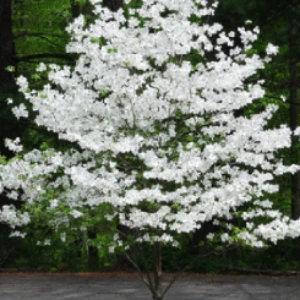
The Cherokee Princess has the classic understory elegance that makes dogwoods so beloved in New England landscapes. In spring, pure white bracts—these are the showy parts that look like petals but are actually modified leaves—create a cloud-like canopy before the true leaves emerge. The bracts are pristine white, sometimes with the tiniest hint of pink at the edges, and they cover the branches so densely that from a distance, the tree looks frosted. The actual flowers are tiny and greenish-yellow, nestled in the center of those bracts.
The summer foliage is a deep, rich green that provides excellent structure to the garden even when the flowers have faded. In autumn, the leaves transform into shades of burgundy and deep red, and by late fall, you’ll see the characteristic bright red berries that the birds absolutely cannot resist. The branching habit is naturally graceful and spreading—no aggressive upright growth here—creating that lovely layered silhouette that makes dogwoods so architecturally important in any Connecticut landscape.
Growing it in your garden
Cherokee Princess Dogwood is native to the southeastern United States, but it has proven itself remarkably adaptable to Connecticut’s climate and growing conditions. It’s happiest in dappled shade or part sun—think of it as an understory tree that appreciates the same conditions it would get naturally beneath tall oaks and maples. While it can handle full sun in cooler Connecticut locations, it actually prefers afternoon shade, especially if your garden tends to dry out in summer.
The soil should be well-draining but consistently moist during the growing season. This is a tree that likes to be hugged by good soil, rich with organic matter. If you’re planting in clay or compacted soil, amend heavily with compost before planting. Acidic to neutral pH is ideal—luckily, much of Connecticut’s native soil leans that direction naturally.
Plant in spring or fall, ideally in spring so the tree has an entire growing season to establish roots before winter stress. Space it where it has room to reach its mature width without crowding—this tree wants breathing room to show off its natural form.
Through the seasons
Spring is when Cherokee Princess truly shines. Those white bracts appear before most other plants have even leafed out, giving your garden an early season wow factor. By early to mid-May here in Connecticut, the display is usually at its peak, and it lasts for several weeks.
Summer brings lush green foliage and the pleasure of dappled shade beneath the canopy. The tree is structurally beautiful even without flowers, with its horizontal branching creating lovely shadows on the ground below.
Fall delivers a burgundy-to-red leaf show, followed by those glossy red berries that persist into early winter. The birds will feast on them, which is wonderful for wildlife but also means you might not see berries lingering through December. That’s okay—it’s nature doing exactly what it should.
Winter reveals the elegant branching structure, and the tree settles into dormancy with quiet dignity, waiting for spring to arrive again.
Where it shines
This is the perfect tree for a woodland edge, a shaded border, or as a focal point in a mixed shrub border. It works beautifully as an understory tree beneath tall oaks. It’s also small enough for residential landscapes where you want a flowering tree that won’t eventually shade out your entire property. Use it near a seating area where you can enjoy the spring bloom from up close, or position it where morning light will shine through those spring bracts.
Perfect companions
Pair Cherokee Princess with shade-tolerant spring bloomers like hellebores, bleeding heart, and Virginia bluebells. Evergreen companions like Christmas fern and holly add winter interest and structure. Underplant with shade-friendly groundcovers like native wild ginger or moss phlox. The horizontal branching of the dogwood creates perfect dappled shade for hostas, astilbes, and other shade perennials.
Care tips
Water regularly during the first growing season to establish a strong root system. Once established, Cherokee Princess is quite drought-tolerant, though it prefers consistent moisture. Prune only to remove dead wood or crossing branches—and do any necessary pruning right after flowering to avoid removing next year’s flower buds. Mulch around the base with 2-3 inches of shredded bark to keep roots cool and moist. This tree is naturally disease-resistant and rarely bothered by pests, which makes it one of the easiest flowering trees you can plant.
Quick facts
- Hardiness Zone: Zones 5-9 (reliable in Connecticut)
- Mature Height & Spread: 20-25 feet tall and wide
- Bloom Season: April-May
- Light Requirements: Part sun to dappled shade (afternoon shade preferred)
- Water Needs: Moderate; consistent moisture preferred, especially when young
- Available at: Both our retail and wholesale locations
