Description

PICEA PUNGENS ‘GLOBOSA’
When you’re tired of tall, narrow conifers dominating your landscape, the Globosa Colorado Blue Spruce arrives like a breath of fresh air. This compact, mounding evergreen rewrites what a blue spruce can be—trading the classic pyramidal silhouette for a dense, globe-shaped form that feels both sculptural and sophisticated. It’s the blue spruce for gardeners who want maximum impact in minimal space, and it delivers that distinctive silvery-blue needles that make this species so captivating, all without requiring a corner lot to accommodate it.
What it looks like
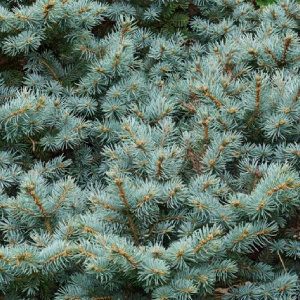
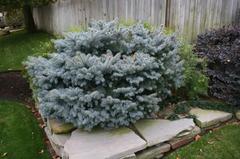
Imagine a perfect sphere of shimmering blue-gray needles, and you’ve got the Globosa. This dwarf variety develops a naturally dense, rounded mound that looks handsome whether it’s highlighted by morning frost or dressed in fresh snow. The needles are that signature Colorado Blue Spruce steel-blue color—striking enough to serve as a focal point but refined enough to integrate seamlessly into almost any design scheme. You’ll notice the texture is slightly softer to the touch than some conifers, with a pleasant waxy quality to those needles. Even in winter, when so many plants fade into the background, the Globosa commands attention with its cool-toned foliage that seems to glow on gray New England days.
Growing it in your garden
Here’s what makes the Globosa such a joy: it asks for very little and gives back consistently. Plant it in full sun—this variety really does shine brightest with six or more hours of direct light daily—and it’ll reward you with that stunning blue coloration that tends to fade in shadier locations. The PICEA PUNGENS ‘GLOBOSA’ prefers well-draining soil and actually appreciates a spot where it won’t sit in perpetual moisture. This matters in Connecticut, where spring runoff and heavy rains are part of our climate reality. Once established, it’s remarkably drought-tolerant, which is increasingly valuable as our summers shift. It doesn’t need coddling, staking, or fussy soil amendments—just straightforward, honest growing conditions.
Through the seasons
Spring brings new growth in a softer, almost chartreuse-tinged color that gradually transitions into that cool blue over the growing season. By summer, the Globosa is fully clothed in its steely foliage, creating a dense screen that doesn’t shed needles like deciduous plants do. Fall passes by with barely a whisper—this is evergreen gardening at its most low-maintenance. Winter is when the Globosa truly earns its place in the landscape. Heavy snow sits beautifully on its rounded form, creating living sculpture in your garden. The blue tones deepen and intensify in cold weather, providing visual warmth even on the bleakest Connecticut afternoon.
Where it shines
This is the perfect blue spruce for foundation plantings, where it won’t outgrow the house or cast the entire north side into permanent shadow. Use it as a specimen plant in a small perennial bed—that globe shape is architectural enough to anchor a design all on its own. It’s wonderful as a screening plant, especially when you want vertical interest without vertical growth. Small urban gardens love this variety because it delivers landscape impact in a 6- to 8-foot package rather than demanding 40 feet of sky. Container gardeners appreciate it too, though it does eventually prefer permanent ground placement. In colder parts of Connecticut where zone 4 conditions prevail, the Globosa proves that blue spruces belong in our region—this isn’t a plant forcing itself into an unsuitable climate.
Perfect companions
Pair the Globosa with golden-foliaged plants like Spiraea ‘Gold Mound’ to create dramatic color contrast. Low-growing sedums at its base echo the density of the form while adding texture interest. The cool blue coloring makes the Globosa an excellent backdrop for warm-colored perennials—think coral, rust, and warm gold tones. Darker green evergreens like ILEX or TAXUS create a refined, sophisticated composition when combined with the Globosa’s silvery tones. Even ornamental grasses thrive alongside it, their movement creating a lovely counterpoint to the Globosa’s solid geometry.
Care tips
The Globosa requires minimal pruning—in fact, it develops its naturally dense, rounded form best when left to its own devices. If you need to remove a damaged branch, do it in late winter before new growth emerges. Water regularly during the establishment year (your first growing season), and then let it take care of itself. It’s not prone to the spider mites that sometimes plague spruces, particularly in hot, dry sites, but good air circulation prevents issues before they start. Avoid fertilizing unless soil tests indicate a genuine deficiency—these are not hungry plants.
Quick facts
- Hardiness Zone: Zones 3–8
- Mature Height & Spread: 6–8 feet tall and wide
- Bloom Season: Evergreen (spring cones)
- Light Requirements: Full sun (6+ hours direct light)
- Water Needs: Medium; drought-tolerant once established
- Available at: Both our retail and wholesale locations