Description
FAGUS SYLVATICA ‘PURPUREA PENDULA’
If you’ve ever stood beneath a weeping willow and thought, “I wish this existed in deep purple,” meet your answer. The Purple Fountain Weeping Beech is a living sculpture—the kind of tree that makes neighbors stop mid-walk to stare. With cascading branches draped like a fountain in rich burgundy-purple and an architectural presence that commands respect, this is the rare specimen tree that actually earns the “specimen” label. It’s not just beautiful; it’s a conversation piece, a focal point, and proof that trees can be both elegant and dramatic.
What it looks like
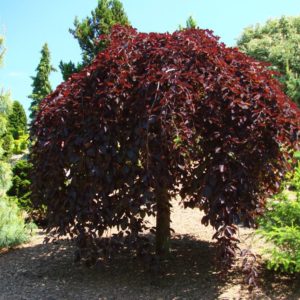
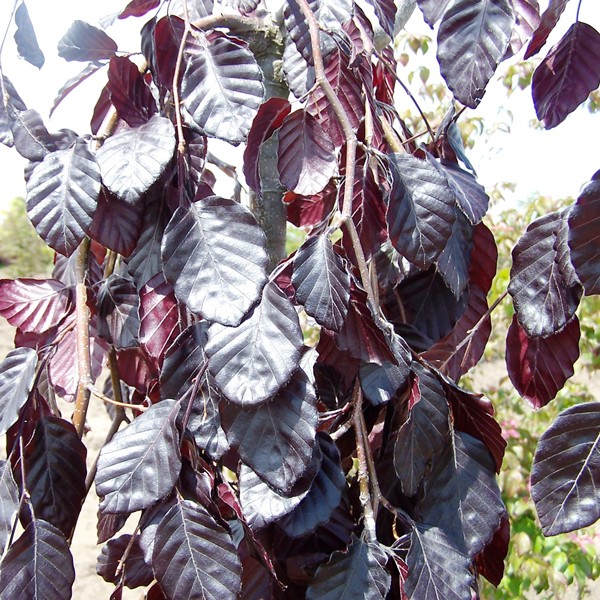
Imagine a fountain frozen mid-spray, then painted in deepest wine-purple. That’s the essence of the Purple Fountain Weeping Beech. Its branches weep dramatically downward in a graceful, pendulous habit, creating a silhouette that’s almost ethereal—especially in spring when new growth emerges in bright burgundy before deepening to that signature dark purple. The foliage is fine and delicate, with leaves that catch the light beautifully, creating subtle color shifts as the season progresses. In autumn, the purple intensifies even further before the leaves drop, revealing a sculptural branching pattern that’s stunning in its own right.
This tree grows with a strong central leader and naturally weeping side branches, creating that distinctive fountain form without heavy pruning. Mature specimens develop a dense, cascading crown that can reach 30-40 feet tall and equally wide, though many gardeners keep theirs more contained.
Growing it in your garden
The Purple Fountain Weeping Beech thrives in Connecticut’s growing conditions when you give it what it wants: full sun to part shade, well-draining soil, and room to breathe. Unlike some fussy specimens, this beech is surprisingly adaptable—it’ll tolerate slightly acidic to neutral soil and actually prefers conditions on the drier side once established. New England’s cool summers suit it beautifully.
This is a tree that deserves a prominent location where its weeping form can be fully appreciated. Plant it in a spot where afternoon shade might be available during our hottest summers, but where it still receives at least 4-6 hours of direct sun daily. The root system is shallow and fibrous, so avoid planting in areas with heavy foot traffic. Give it space to grow without competing for resources—this tree wants to be the star of the show.
Through the seasons
Spring brings one of the year’s most striking moments: new growth emerging in glowing burgundy-red, creating an almost luminous effect as sunlight filters through the young foliage. By early summer, that purple deepens and the tree reaches full leaf, offering reliable shade and that sculptural presence that never gets old.
Summer sees the Purple Fountain Weeping Beech settle into its role as a living focal point—the deep purple canopy providing striking contrast against the green of surrounding plantings. Fall amplifies the color drama as the leaves deepen further, taking on almost chocolate-wine tones before dropping. Winter reveals the true architectural beauty: the framework of gracefully weeping branches, elegant and spare, adding winter interest that many gardens desperately need.
Where it shines
This is a specimen tree, meaning it deserves its own moment rather than being tucked into a mixed border. It’s spectacular as a focal point in a larger landscape, stunning positioned where it can be viewed from a distance or from a patio or window. Use it to anchor a garden room, frame a pathway, or create a dramatic focal point in a formal garden setting.
The Purple Fountain Weeping Beech also makes an elegant statement in estates, larger residential properties, and public gardens. It’s sometimes used as a single specimen in a sea of lawn, though it truly shines when given complementary plantings nearby. The upright branching structure makes it suitable for properties where space is a consideration, as its footprint spreads more outward than upward.
Perfect companions
The deep purple foliage of this weeping beech pairs beautifully with silver-foliaged plants like ARTEMISIA and dusty miller, which echo and brighten the darkness. Consider underplanting with shade-tolerant hostas or hellebores in lighter green or chartreuse tones to create contrast. Japanese maples in complementary colors (perhaps a golden cultivar) positioned nearby create stunning seasonal dialogues. Evergreen companions like emerald-green boxwoods provide year-round structure once the beech loses its leaves.
Care tips
Water regularly during the first year to establish a strong root system, then reduce watering as the tree becomes established. Mulch around the base to retain moisture and regulate soil temperature, but keep mulch pulled back from the trunk. Pruning is minimal—remove any dead or crossing branches and maintain the natural weeping form. Beech trees can be susceptible to beech scale in some regions, so monitor for this pest and treat early if needed. Avoid injuring the bark or compacting soil around the root zone.
Quick facts
- Hardiness Zone: Zones 4-7 (perfect for Connecticut)
- Mature Height & Spread: 30-40 feet tall and wide
- Bloom Season: Non-flowering; ornamental for foliage and form
- Light Requirements: Full sun to part shade
- Water Needs: Moderate; prefers well-draining soil
- Available at: Both our retail and wholesale locations.