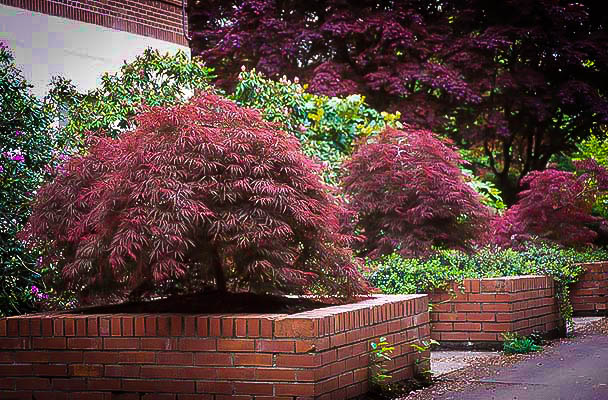
Description
ACER PALMATUM ‘EVER RED’
If you’re drawn to Japanese maples but worry they’re too fussy for Connecticut gardens, let us introduce you to EVER RED—a variety that combines the refined elegance you crave with the toughness your garden actually needs. This is a tree that doesn’t ask for coddling, yet delivers the kind of year-round beauty that makes neighbors stop and stare. Deep, wine-dark foliage that holds its color from spring through fall, paired with an architectural branching structure that’s stunning even in winter: this is what happens when you find the perfect Japanese maple.
What it looks like
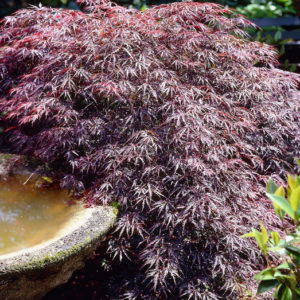
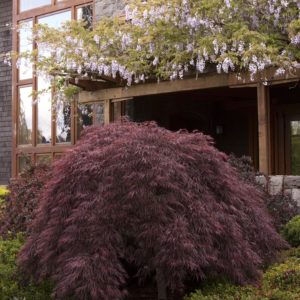
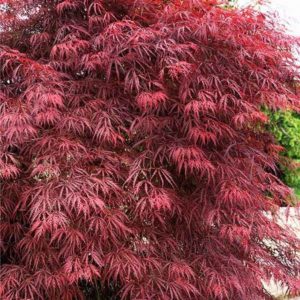
EVER RED is a study in deep jewel tones. The delicate, deeply dissected leaves emerge in spring with burgundy-red coloring, maintaining that rich, wine-tinged hue throughout the growing season—unlike many Japanese maples that fade to green by summer. You won’t see the typical chartreuse or bronze that other varieties display. Instead, expect a consistent, sophisticated reddish-purple that practically glows when backlit by morning or evening sun. The leaf texture is finely cut, almost lacy, creating a refined silhouette that’s never heavy or coarse. In fall, the color deepens even further, becoming almost crimson before dropping to reveal delicate branching that adds sculptural interest through winter. The overall form is naturally upright and somewhat spreading, creating an elegant, tiered canopy that works beautifully as a specimen tree or focal point.
Growing it in your garden
Here’s what makes EVER RED special for New England gardeners: it’s far more forgiving than many Japanese maple varieties. While these trees are sometimes painted as temperamental, EVER RED has proven itself hardy and reliable across Connecticut. Give it a spot with dappled shade—morning sun and afternoon shade is ideal, especially in our hotter summers. It appreciates soil that drains well but doesn’t dry out completely; in Connecticut’s clay-heavy soils, amending with compost before planting makes a real difference. The tree prefers slightly acidic conditions, which is common in our region. Protected from harsh afternoon sun and strong winds will help preserve those perfect leaves and prevent scorching during dry spells. Once established, it settles in nicely and requires far less fussing than its reputation suggests.
Through the seasons
Spring arrives with burgundy-red emerging foliage that’s almost luminous. As the tree leafs out fully, that deep red coloring persists, making it a standout when most trees are wearing cheerful greens. Tiny flowers appear in spring—inconspicuous but delicate—followed by the main event: steady, reliable color all summer long when other trees are looking tired in August heat. Fall is where things get truly dramatic. The wine-red deepens to crimson, creating a display that rivals any sugar maple for intensity, though on a more intimate, personal scale. Winter reveals the tree’s elegant branching pattern, which has an almost bonsai-like quality. It’s never bare and lonely-looking; instead, it’s architectural and beautiful in a quieter way.
Where it shines
Plant EVER RED where you want year-round interest—as a specimen tree in a mixed border, near a patio where you’ll see it from inside, or as a focal point in a shade garden. It’s wonderful paired with shade-loving perennials, ferns, and hostas that let its foliage take center stage. Because it doesn’t grow aggressively large, it works in modest-sized yards where a full-size tree would overwhelm. It’s also excellent for contemporary gardens where its refined branching pattern complements clean lines and minimalist design. In a Japanese-inspired garden, EVER RED is practically essential.
Perfect companions
Underplant with shade-tolerant hostas—the contrast between your EVER RED’s fine texture and a hosta’s bold leaves creates stunning visual tension. Japanese forest grass (HAKONECHLOA MACRA) looks ethereal beneath it. Ferns like autumn fern (DRYOPTERIS ERYTHROSORA) echo the color without competing. For blooms, consider hellebores or coral bells, which add flowers while respecting the maple’s starring role. In a larger space, pair it with dwarf conifers that echo its upright form.
Care tips
Water regularly during establishment and through dry Connecticut summers—young trees appreciate consistent moisture their first two seasons. Avoid fertilizing heavily; these trees prefer leaner soil and excessive nutrients can push weak growth. Prune only to remove dead branches or improve structure; Japanese maples resent heavy pruning. Watch for spider mites during hot, dry spells (mist foliage if needed), and monitor for scale, though EVER RED is generally healthy. No serious pest or disease problems plague this variety. A light mulch layer keeps soil consistently moist and cool.
Quick facts
- Hardiness Zone: 5-8
- Mature Height & Spread: 15-20 feet tall and wide
- Bloom Season: Spring (inconspicuous flowers)
- Light Requirements: Dappled shade; morning sun/afternoon shade
- Water Needs: Moderate; consistent moisture preferred
- Available at: Both our retail and wholesale locations